Have to give an ENORMOUS shout to the Leather Helmet Blog as they were the original posters of the first two videos you will see below. You can draw your own conclusions, most assuredly, but it's definitely clear that the approach that Dave Van Halanger takes at Georgia is a bit modest in comparison to others around the country.
Heck, let's be real, when compared to the program run by Benny Wylie at the University of Tennessee, Georgia's program looks like a Gymboree class.
Please, feast your eyes on this training video, for the "advanced athlete", presented by Georgia's strength and conditioning coach—Dave Van Halanger:
Now, did he really say three sets of ten? Now, no one here is professing to be an expert, but, shouldn't the routine be a touch more challenging—these are football player after all.
The video above looks like it needs to be for the beginning athlete, not the advanced one and, production quality aside, no coach in the SEC is going to be rushing out the door looking for Van Halanger's regimen in any manual if this is what he's bringing to the table—hell, I can do three sets of ten!
Is he for real?!?
Now, take a look at Tennessee's strength coach, Benny Wylie, and ask yourself one question: could anyone describe him as soft?
"If you suffer as a group, you'll normally bond, and that's what we try to do. We put our guys through intense training, hard training, things that the normal person can't do—couldn't do—and we forge our guys together in the summer..."
Well, that sounds like a great idea: "suffer as a group and bond". Haven't seen too much bonding on the Georgia football field lately, could that be a part of the reason why? Just asking questions, here, because it seems that not enough light is being shined on Dave Van Halanger just yet and there has to be some accountability swept his way too.
But, no worries, right? The guys on the field can still lift with the best of them:
Showing posts with label Coach (sport). Show all posts
Thursday, September 30, 2010
Thursday, September 9, 2010
Vince Dooley on the Georgia Bulldogs' 1980 Championship Team: "Herschel Was That Missing Piece" (VIDEO)
Former Georgia Bulldogs football coach, Vince Dooley, took a moment to sit down for an interview with the University of Georgia's student newspaper, the Red and Black, just prior to the start of Georgia's 2010 football season. In this taped interview, Dooley discusses not only the 1980 National Championship won by his team, but also what he feels is the future of the football program at Georgia.
The interview is in two parts: (h/t to wrbrown4):
Part 2...Vince Dooley on why Georgia hasn't won a national championship since 1980:
The interview is in two parts: (h/t to wrbrown4):
Part 2...Vince Dooley on why Georgia hasn't won a national championship since 1980:
Sunday, June 27, 2010
The NCAA Needs To Tighten It's Rules Regarding Facebook Contact
The NCAA needs to decide what is and isn't okay where Facebook is concerned. According to Kyle Veazey of the ClarionLedger.com, Ole Miss may be in line for a "secondary" recruiting violation after assistant coach, Chris Vaughn, commented on the public wall of Mississippi State commit, Jermaine Whitehead—the NCAA does not allow this.
However, here's the kicker:
Let me explain my perplexed state, the NCAA does allow a coach to send private messages to a potential prospect. How is that not intrusion? After all, the NCAA would have zero knowledge of what's said or sent in that message.
So a coach can decide to compile a video presentation featuring an ESPN highlight reel of the prospect's future accomplishments and opportunities if he chose to sign with their school, link that video as a part of the private message, and the NCAA would have no idea—how is that okay?
Of course, one might say that the same can be done in a recruits living room or on their official visit—the NCAA won't be present in those situations either.
That's a point well-taken but as stated above, limits are imposed on the amount of contact a program can make with a potential recruit. Visits to the home and/or the school are set in advance. There are specific guidelines one fact-to face contact and telephone calls. This is not the same thing as being allowed to send a private message on a social medium.
Social mediums provide the added bonus of being able to attach video messages that can, indirectly, be considered face-to-face contact. A coach could video himself talking one-to-one with a recruit and no one would be the wiser—including the NCAA.
Again...I am perplexed.
A "secondary violation" amounts to nothing so Ole Miss is likely willing to take a calculated risk if it nets them a player—assuming that they truly did anything at all. If nothing else, Facebook has proven to be a place where you can be anyone you wish to be—identities are rarely verified unless a barrage of complaints are levied against a particular user. So this whole thing could be a whole lot of nothing.
If not, the NCAA needs to consider the legitimacy of this rule altogether because at the simplest level it doesn't make a lick of sense.
However, here's the kicker:
“Our members are concerned about the level of intrusion in a young person’s life related to recruiting, and the celebrity culture that can develop around the recruitment process, which is why limits are placed on how often coaches can contact recruits,” NCAA spokesperson Stacey Osburn said. (ClarionLedger.com, 6/26/10).Huh?
Let me explain my perplexed state, the NCAA does allow a coach to send private messages to a potential prospect. How is that not intrusion? After all, the NCAA would have zero knowledge of what's said or sent in that message.
So a coach can decide to compile a video presentation featuring an ESPN highlight reel of the prospect's future accomplishments and opportunities if he chose to sign with their school, link that video as a part of the private message, and the NCAA would have no idea—how is that okay?
Of course, one might say that the same can be done in a recruits living room or on their official visit—the NCAA won't be present in those situations either.
That's a point well-taken but as stated above, limits are imposed on the amount of contact a program can make with a potential recruit. Visits to the home and/or the school are set in advance. There are specific guidelines one fact-to face contact and telephone calls. This is not the same thing as being allowed to send a private message on a social medium.
Social mediums provide the added bonus of being able to attach video messages that can, indirectly, be considered face-to-face contact. A coach could video himself talking one-to-one with a recruit and no one would be the wiser—including the NCAA.
Again...I am perplexed.
A "secondary violation" amounts to nothing so Ole Miss is likely willing to take a calculated risk if it nets them a player—assuming that they truly did anything at all. If nothing else, Facebook has proven to be a place where you can be anyone you wish to be—identities are rarely verified unless a barrage of complaints are levied against a particular user. So this whole thing could be a whole lot of nothing.
If not, the NCAA needs to consider the legitimacy of this rule altogether because at the simplest level it doesn't make a lick of sense.
Friday, June 18, 2010
The Georgia Bulldogs Are Selling A Dream—Haters Be Damned!
It seems that not everyone is enamored of the Georgia Bulldogs and their “Dream Team” approach to recruiting prospects for 2011. More and more, there are those who are taking issue with the idea as they wonder if it’s really something that they want Georgia to be hanging its future success upon.
The first issue is believing in the notion that one recruiting class is going to be the answer for Georgia football—fair enough. I mean, after all, it takes more than one group of players to transform a program from good to great, right?
Even if this class does end up being championship caliber, there is no guarantee that it will come together immediately. That’s an important point to consider when you think of the sensitive position that Mark Richt is currently under at Georgia—his seat may not be hot but, after 2011, it will get substantially warmer if the program regresses or experiences another sub-par season.
Which leads to the other issue posed by the naysayers, why put that much expectation on one group of players, on the Georgia football program, heck, on Mark Richt?!? Does he really need to see the consequences of his “Dream Team” idea backfiring on him?
The magnifying glass is close enough without adding fuel to the fire.
Now, while I can certainly understand both sides, all the vitriol has led me to one very simple question, why is anyone bothering to take this approach so seriously?
Mark Richt has offered the concept of a "Dream Team" to help fire up the in-state talent’s interest in Georgia, as well as infuse the fans with a little more enthusiasm for the future of Georgia football—that's it.
Honestly, anyone who believes a recruit will sign, based solely on the possibility of being a part of the "Dream Team", is not being realistic. Even more, they aren’t giving Georgia or Mark Richt much credit as a program. If a prospect signs with Georgia, he will ultimately do so as a result of how well he fits in at Georgia.
All Georgia’s staff has done is offer the excitement of, possibly, being a part of something special at Georgia in 2011. They could be a part of building Georgia into a champion. They might be the missing piece of the championship puzzle.
It’s that pitch that could pique the interest of a potential prospect enough to allow a Georgia coach his shot at selling the merits of playing in a red and black uniform—is that a crime?
After all, in the recruiting game, part of the process entails gaining an ‘edge’. If a particular concept can give you one, then you take advantage of the opportunity. The “Dream Team” sounds good to some of the guys it’s being presented to, others maybe not as much, but all any coach can ask for is a chance to make his pitch and so far, "Dream Team" or not, the coaches are selling the program.
Will they get everyone? No, they will miss a few, and I have no doubt that the coaches and Richt know as much.
That said, if the staff fails to close on a guy, it will have less to do with an inability to sell the “Dream Team” concept, than with Georgia failing to promise something the recruit values (i.e. playing time, location, or position).
You simply can’t sign everyone.
Georgia has received 12 solid commitments—11 of whom are in-state—none of whom actually cite the "Dream Team" as their reason for choosing Georgia. So I am forced to, wonder again, why anyone has a problem with the coaches using this idea as a tool in recruiting?
For now, the “Dream Team” is nothing more than part of an effective sales pitch and, in the end, the coaches still have to sell the program. So far, they have done a good job of that.
The first issue is believing in the notion that one recruiting class is going to be the answer for Georgia football—fair enough. I mean, after all, it takes more than one group of players to transform a program from good to great, right?
Even if this class does end up being championship caliber, there is no guarantee that it will come together immediately. That’s an important point to consider when you think of the sensitive position that Mark Richt is currently under at Georgia—his seat may not be hot but, after 2011, it will get substantially warmer if the program regresses or experiences another sub-par season.
Which leads to the other issue posed by the naysayers, why put that much expectation on one group of players, on the Georgia football program, heck, on Mark Richt?!? Does he really need to see the consequences of his “Dream Team” idea backfiring on him?
The magnifying glass is close enough without adding fuel to the fire.
Now, while I can certainly understand both sides, all the vitriol has led me to one very simple question, why is anyone bothering to take this approach so seriously?
Mark Richt has offered the concept of a "Dream Team" to help fire up the in-state talent’s interest in Georgia, as well as infuse the fans with a little more enthusiasm for the future of Georgia football—that's it.
Honestly, anyone who believes a recruit will sign, based solely on the possibility of being a part of the "Dream Team", is not being realistic. Even more, they aren’t giving Georgia or Mark Richt much credit as a program. If a prospect signs with Georgia, he will ultimately do so as a result of how well he fits in at Georgia.
All Georgia’s staff has done is offer the excitement of, possibly, being a part of something special at Georgia in 2011. They could be a part of building Georgia into a champion. They might be the missing piece of the championship puzzle.
It’s that pitch that could pique the interest of a potential prospect enough to allow a Georgia coach his shot at selling the merits of playing in a red and black uniform—is that a crime?
After all, in the recruiting game, part of the process entails gaining an ‘edge’. If a particular concept can give you one, then you take advantage of the opportunity. The “Dream Team” sounds good to some of the guys it’s being presented to, others maybe not as much, but all any coach can ask for is a chance to make his pitch and so far, "Dream Team" or not, the coaches are selling the program.
Will they get everyone? No, they will miss a few, and I have no doubt that the coaches and Richt know as much.
That said, if the staff fails to close on a guy, it will have less to do with an inability to sell the “Dream Team” concept, than with Georgia failing to promise something the recruit values (i.e. playing time, location, or position).
You simply can’t sign everyone.
Georgia has received 12 solid commitments—11 of whom are in-state—none of whom actually cite the "Dream Team" as their reason for choosing Georgia. So I am forced to, wonder again, why anyone has a problem with the coaches using this idea as a tool in recruiting?
For now, the “Dream Team” is nothing more than part of an effective sales pitch and, in the end, the coaches still have to sell the program. So far, they have done a good job of that.
Tuesday, June 8, 2010
The Big East Wants Coaching Staff Sizes To Be Smaller
An article published in USA Today states that the NCAA cabinet is looking into introducing legislation that would limit the support staff allowed in college football programs.
Currently, the NCAA places a limit on the number of coaches that can be involved with assisting the players—on or off the field. That number, currently, is capped at 12 (the head coach, nine assistants, and two graduate assistants).
However, it gets a little sketchier when discussing non-coaching personnel. There are no limits to that number and, just a quick browse of some of the more well-known programs in college football will attest to that; Ohio State (41), Rutgers (36), and Michigan (33) all boast large amounts of non-coaching staff on their payroll.
The latter was recently forced to impose a self-sanction on their football program when it was discovered that inappropriate actions were being executed by the non-coaching staff hired by head coach, Rich Rodriguez. The report was stated as such:
Currently, the NCAA places a limit on the number of coaches that can be involved with assisting the players—on or off the field. That number, currently, is capped at 12 (the head coach, nine assistants, and two graduate assistants).
However, it gets a little sketchier when discussing non-coaching personnel. There are no limits to that number and, just a quick browse of some of the more well-known programs in college football will attest to that; Ohio State (41), Rutgers (36), and Michigan (33) all boast large amounts of non-coaching staff on their payroll.
The latter was recently forced to impose a self-sanction on their football program when it was discovered that inappropriate actions were being executed by the non-coaching staff hired by head coach, Rich Rodriguez. The report was stated as such:
The school said two main problems - too many people acting as coaches and too many hours being put into football by the players - occurred in part because of "inattention by the football staff."
After his hire from West Virginia, Rodriguez filled all five quality control positions in the program - essentially assistants to assistants who were paid $17 per hour to "run errands for the coaches, check on student-athlete class attendance and academic issues, and chart plays."
The school said the staff "crossed the line in specific situations and engaged in 'coaching activities"' as defined by the NCAA.
The NCAA has stated that this recent discovery has little to do with their decision to introduce this new legislation, but, it has shed some light on an issue that has long been on the minds of those involved on the Football Issues Committee.
Big East associate commissioner and chair of the NCAA Football Issues Committee, Nick Carparelli, stated the following:
"There's a unanimous position (among Big East coaches) that football staffing positions need to be regulated. There are just too many. The Big East coaches feel that there are some schools that have staffs that are so big that it raises the question of what these people can be doing within the rules."That being said, however, why is the Big East's associate commissioner championing this cause with any more urgency than any other conference?
If there is an issue with non-coaching staff doing inappropriate business at one school, isn't it just as likely that it is happening at another? After all, what major program isn't trying to find a way around some of the vaguer rules of the NCAA?
In truth, it won't likely matter how many staff members are supported by a major football program. The relative edge offered by having one extra strength coach or one additional director of football operations seems comical in the broader sense.
Even more, the notion that the NCAA is "...very concerned about the cost of this kind of proliferation and whether it's necessary to … putting our teams in the field of play,"seems ironic given their lackadaisical handling of all things college football related.
After all, additional staff within a football program isn't a new phenomenon. This type of behavior, on the behalf of athletic director's and head coached, has been going on since the days of Bear Bryant. Back then college coaches would send out, and in many instances pay, scouts to evaluate high school talent.
At that time, there were no recruiting services in college football and the act of evaluating talent for money was a far-fetched idea. This was long before the days of a Rivals Top 100 or a Scout 150 so the act it self, at one point, believe it or not, was considered cheating.
The point is, coaches did what they felt was necessary to gain an extra step on the competition and, no matter what the NCAA Football Issues Committee, comes up with—I don't expect that to change. And, based on the way the NCAA has handled the whole USC—sanction or no sanction debacle—I'd say they are well-aware of that fact.
Saturday, June 5, 2010
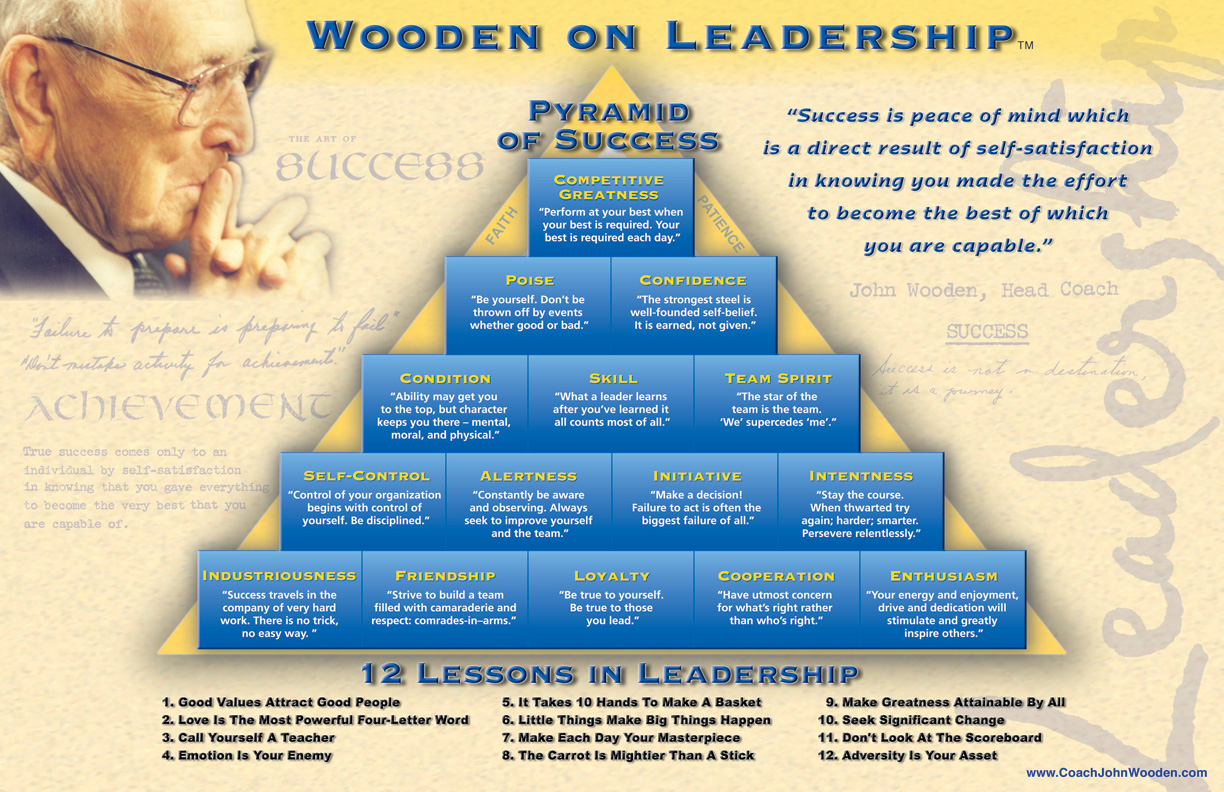
R.I.P John Wooden—One of the Great Ones
A few video clips of the former UCLA coaching great who died yesterday at 99.
John Wooden interview with Roy Firestone (3 separate years):
John Wooden's final game as the coach of the UCLA Bruins. His 10th National Championship:
Kareem Abdul-Jabbar on Wooden:
John Wooden's Famous 'Pyramid of Success':
"Make each day your Masterpiece"--John Wooden
John Wooden interview with Roy Firestone (3 separate years):
John Wooden's final game as the coach of the UCLA Bruins. His 10th National Championship:
Kareem Abdul-Jabbar on Wooden:
John Wooden's Famous 'Pyramid of Success':
"Make each day your Masterpiece"--John Wooden
Subscribe to:
Posts (Atom)