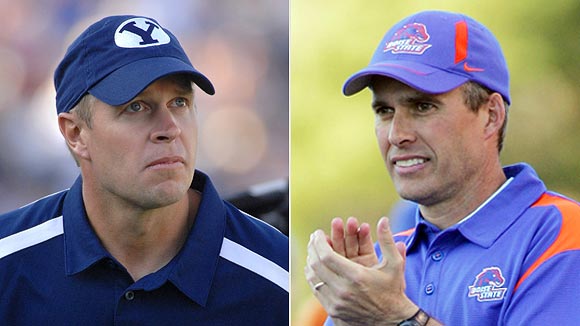
Boise State could not have imagined that their decision to leave the Western Athletic Conference (WAC) for the Mountain West Conference (MWC) would have been met by such an utter upheaval.
In the time since the Broncos made said decision to leave the "Little Sisters of the Poor" (AKA Gordon Gee's description of Boise's conference mates) behind, the strongest members of the MWC (BYU, Utah, and TCU) have all jumped ship.
Utah accepted an invite in mid-June to join the Pac-10. Shortly thereafter, BYU decided to become an independent in football—with all their other sports joining the West Coast Conference. Now, today, TCU has accepted an invitation to join the Big East conference.
The latter action has to have the powers that be at Boise State scratching their collective heads—essentially, the MWC just became the WAC.
Boise is no longer adding it's strong record and television appeal to a major, non-BCS, conference in the hopes of making it legitimate but, rather, joining a conference that will now be looking to them for any form of legitimacy—talk about getting the short end.
While you can hardly blame Utah, BYU, or TCU for trying to get their shot at an automatic qualifying (AQ) bid in a BCS conference, you have to feel a little sorry for Boise State because they just seem to keep missing out on acceptance.
Seriously, what can they possibly do now? They will be in no better a position in 2011 than they were in 2010.
Of course the MWC will add more teams, but with BYU and Utah now gone, and TCU exiting in 2012, how many advertisers will be chomping at the bit to see MWC games on national television—in primetime? Better still, what does this mean for the Mountain West's network? Boise might be a media darling, but they aren't a huge draw all by themselves—and no one is going to be lining up to see them play Colorado State, New Mexico, or Wyoming.
Boise State can't seem to catch a break. They're either damned if they do, or damned if they don't and they have to be feeling a bit piled on by this point. Perhaps they've been right all along—no teams want to play them.
Showing posts with label Western Athletic Conference. Show all posts
Monday, November 29, 2010
Wednesday, November 24, 2010
College Football: Honestly, The Odds Are Against TCU and Boise State Playing for a Title
It's a legitimate question to ask. After all, both Auburn and Oregon are playing legitimate teams this weekend while TCU and Boise State are playing...wait, who are they playing again? Oh yeah, TCU is playing 1-10 New Mexico while Boise gets challenged by 10-1 Nevada.
Listen, there is no need to debate the merits of how worthy either TCU or Boise are where being granted a BCS National Championship berth is concerned because, well, neither of them deserve a shot at the title based on the schedules they've played—specifically when placed up against that of either Oregon or Auburn.
That said, the BCS isn't about strength of schedule—that makes only a small difference where their overall ranking is concerned—so, if Auburn and Oregon both lose, while TCU and Boise State both win out, they should, hypothetically, get the nod—right?
Well, that isn't likely going to happen and you don't have to agree with the math or pour over stats and historical precedent to see the writing on the wall as to why. Just look at the landscape of college football this season, and note the conversations—the BCS big boys never counted on either TCU or Boise State still being undefeated by this point.
Can we be honest about that much?
Seriously, Boise was "supposed" to lose to Virginia Tech to start the year. They were not supposed to win that game, playing in hostile territory, on a national stage, against a Frank Beamer-coached team—no way, no how. They caused a collective jaw-drop when they walked off Fed-Ex field victorious because the naysayers knew the consequence of such an act was another run for Boise State in 2010.
It wasn't a hard record to predict because, to be honest, watching Boise play any team in the WAC is a lot like watching a friend play NCAA 2011 on rookie mode—boring and unimpressive. They are, literally, the best team on the field every week because there isn't one team in the WAC that can hold their water bottles.
As for TCU, they kept defying the odds, too.
Some felt Oregon State might have beaten them, but the Beavers didn't seem to feel that way and, as usual, they proved to be ineffective in a big game—outside of the state of Oregon.
Then there was the game against Utah. "Oh my, TCU has NEVER won in Salt Lake City and the Utes are a very good football team". Yeah, and the powers that be were so solid in their conviction of that game that they left it off the national schedule—it wasn't even offered to 70 percent of the college football viewing public.
Honestly, it seems like the big boys aren't all that interested in letting the non-BCS schools come sit next to them at the dinner table. They want them to be content to catch whatever scraps they drop from their meal so, if either Oregon or Auburn lose their games, there is little likelihood that either TCU or Boise will have enough points to jump over them—"no one wants to see that game, so let's keep it from happening".
Of course, most of this sounds like a conspiracy theory, and there is no way to prove that any of this will actually come to fruition unless the Top 2 teams in the nation actually lose. However, consider this, Boise State opened the year ranked 3rd in the nation, yet they've never managed to get higher than that—despite annihilating every team they've played.
Even TCU has jumped them...despite the fact that the Horned Frogs barely beat San Diego State last weekend.
Is it fair? You be the judge, but it's becoming more and more obvious that there is definitely no balance and, in truth, there doesn't seem to be many people who care if it ever actually is.
Wednesday, September 1, 2010
Boise State Would Contend For An SEC Championship?...Andrea Adelson, Surely You Jest
Andrea, Andrea, Andrea. It's not enough that you had the idiotic gall to rank the Georgia Bulldogs No. 64 in a recent preseason poll, but you are still finding ways to take pot shots at the Bulldogs now that the idiots over at E$PN have seen fit to give you a job—when will you ever learn.
Yesterday, Chris Low was paired up against Andrea Adelson in a blogger debate (h/t Get The Picture). The question was whether or not a one-loss SEC team would get the nod over an undefeated Boise State team for a shot at the BCS national title and would Boise State be able to survive an SEC schedule?
Chris Low, of course, said that a one-loss SEC team would be more worthy of a title shot than an undefeated Boise State—no question. Furthermore, Boise State would find it very difficult to go undefeated on a yearly basis if they had to contend with the SEC's schedule.
No argument from me there.
Well, proving once again that you simply cannot fix stupid, Ms. Adelson had this to say:
Let's forget for a moment that Boise State has yet to beat an SEC opponent. Let's not even discuss that fact—yet. No, no...let's focus in on this little gem again: "And which of these mighty SEC teams would take down Boise State? Georgia?"...tell me she didn't go there!
If memory serves, and mine is pretty dang good, Georgia played Boise State in 2005—and DEMOLISHED them 48-13. Sure, that was a different coach, a different team, and a different time for Boise State, but to insinuate that in the past four years Boise has become exponentially better than Georgia just because you are an obvious Gator homer is beyond ridiculous—it's ludicrous.
Boise is a WAC team in a WAC conference. They have played four SEC opponents in their history and lost all four times. It doesn't matter how good their smoke screen is right now, the fact remains that they haven't done well, overall, against the SEC, the Pac-10, the Big Ten, or the ACC—all of which receive automatic bids from the BCS sooooooo...you do the math.
Now, the entry yesterday may have attempted to offer a more balanced approach to Boise's situation in the BCS but, rest assured, this author is not yet ready to sip the kool-aid.
"Contenders for an SEC Championship"? Ay, yi, yi...wake me when the stupidity is over.
Yesterday, Chris Low was paired up against Andrea Adelson in a blogger debate (h/t Get The Picture). The question was whether or not a one-loss SEC team would get the nod over an undefeated Boise State team for a shot at the BCS national title and would Boise State be able to survive an SEC schedule?
Chris Low, of course, said that a one-loss SEC team would be more worthy of a title shot than an undefeated Boise State—no question. Furthermore, Boise State would find it very difficult to go undefeated on a yearly basis if they had to contend with the SEC's schedule.
No argument from me there.
Well, proving once again that you simply cannot fix stupid, Ms. Adelson had this to say:
"And which of these mighty SEC teams would take down Boise State? Georgia? Tennessee? Ole Miss? Mississippi State? The Broncos would be favored against every SEC team this year except two. This is nothing against the SEC. I think it is the best conference in the country. But to say Boise State would be in over its head in the league is a specious argument. The Broncos are proven winners and would absolutely be contenders for an SEC championship. "Excuse my french for just a second, but...the HELL you say?
Let's forget for a moment that Boise State has yet to beat an SEC opponent. Let's not even discuss that fact—yet. No, no...let's focus in on this little gem again: "And which of these mighty SEC teams would take down Boise State? Georgia?"...tell me she didn't go there!
If memory serves, and mine is pretty dang good, Georgia played Boise State in 2005—and DEMOLISHED them 48-13. Sure, that was a different coach, a different team, and a different time for Boise State, but to insinuate that in the past four years Boise has become exponentially better than Georgia just because you are an obvious Gator homer is beyond ridiculous—it's ludicrous.
Boise is a WAC team in a WAC conference. They have played four SEC opponents in their history and lost all four times. It doesn't matter how good their smoke screen is right now, the fact remains that they haven't done well, overall, against the SEC, the Pac-10, the Big Ten, or the ACC—all of which receive automatic bids from the BCS sooooooo...you do the math.
Now, the entry yesterday may have attempted to offer a more balanced approach to Boise's situation in the BCS but, rest assured, this author is not yet ready to sip the kool-aid.
"Contenders for an SEC Championship"? Ay, yi, yi...wake me when the stupidity is over.
Saturday, August 21, 2010
College Football: The Mountain West Wants R-E-S-P-E-C-T...Will They Ever Get It?
The Mountain West Conference (MWC), the oft mentioned but frequently disrespected conference in the FBS, has finally gone off the deep end in it's search for that elusive Automatic Qualifying (AQ) bid from the BCS powers that be—good luck with that if this turns out to be your method of getting there.
According to a recent report, offered via College Football Talk, the MWC and Conference-USA (C-USA) are in the very early stages of a discussion that would pit the MWC Champion against the C-USA Champion in a "play-in" game. The winner would be awarded an AQ bid by the BCS.
Okay, first of all, in what universe would a play-in game versus a C-USA opponent be an attractive package for the BCS?...Seriously?
The recent successes of East Carolina and Houston aside, the overall success of C-USA against current opponents that fall under the AQ umbrella is not impressive—at all. As a matter of fact, the conference as a whole sports a losing percentage against the Big XII (0.383), the ACC (0.377), the SEC (0.334), the Big Ten (0.209), and the Pac-10 (0.322). Shoot, they even have a poor winning percentage against the MWC (0.400).
*scratching my head*
Explain to me again how this idea would be attractive to the BCS?
C-USA might house some great offensive powerhouses in Tulsa, Rice, Houston, and Memphis, but they are far from ready to compete with some of the bigger and better programs of the Big Ten and the SEC—that's laughable.
Admittedly, these discussions are in their infancy and neither side is ready to confidently go forth and present this option to anyone with the power to change things, but the mere fact that this step is being talked about at all puts a glaring spotlight on how badly the MWC is trying to gain legitimacy—they are tired of being the have-nots of college football.
I can't say that I blame them, the Boise State Broncos have gotten more respect as one team in a remarkably unchallenging conference than BYU or TCU have gotten playing in the MWC.
Boise State may have the more attractive record over the last 6-years (bolstered in large part by a 31-1 conference record), including BCS wins over Oklahoma and TCU, but their conference schedule continues to be a joke and their undefeated record at the end of the year seldom houses a quality win over a quality opponent. They play just as many pansies in their OOC match-ups as they do in their own conference—yet they are rewarded for it time and again.
Consider this, the Broncos, under Chris Petersen, are 4-1 against BCS teams that play in a conference with an AQ bid. Those four wins came against Oregon (2-0), Oregon State (1-0), and Oklahoma (1-0). BYU, in that same span of time, is 7-5 against BCS teams with an AQ bid. Their seven wins came against Oregon (1-0), Oregon State (1-0), Oklahoma (1-0), UCLA (2-1), Washington (1-0) and Arizona (1-2)—three of the five losses were against the ACC.
TCU has fared even better, going 7-2 against AQ opponents—including wins over Stanford, Texas Tech, and Clemson.
Last I checked, Boise State hasn't played the ACC, under Chris Petersen, yet. For that matter, they haven't played a team from the SEC or the Big Ten either—just saying.
Oh, I know...no one wants to play Boise because they're scared they'll get pummelled. Uh huh, okay. I really wish people would stop making Boise sound so much better than they are because it's getting old.
A large part of the reason why no one wants to play Boise is because they aren't interested in doing a home-and-home series with them. Texas, Florida, USC, Ohio State, etc., don't need to dole out more money in travel than they will get in gate and concession receipts for going out to Idaho to play in a stadium that maxes out at 32,000—gimme a break.
Boise isn't scary, they are unreasonable and seem to forget they play in the WAC.
They play one relevant game a season and the media wants to anoint them as better than the other 119 Division-I teams that play in the FBS—it's pathetic and, personally, I'm tired of it.
Yet, I digress.
The MWC has been crapped on for years now, despite the success of BYU, Utah, and TCU and they are tired of it. Unfortunately for them, they are barking up the wrong tree with this idea as it will amount to a whole lot of nothing if they ever do bring it to the table.
According to a recent report, offered via College Football Talk, the MWC and Conference-USA (C-USA) are in the very early stages of a discussion that would pit the MWC Champion against the C-USA Champion in a "play-in" game. The winner would be awarded an AQ bid by the BCS.
Okay, first of all, in what universe would a play-in game versus a C-USA opponent be an attractive package for the BCS?...Seriously?
The recent successes of East Carolina and Houston aside, the overall success of C-USA against current opponents that fall under the AQ umbrella is not impressive—at all. As a matter of fact, the conference as a whole sports a losing percentage against the Big XII (0.383), the ACC (0.377), the SEC (0.334), the Big Ten (0.209), and the Pac-10 (0.322). Shoot, they even have a poor winning percentage against the MWC (0.400).
*scratching my head*
Explain to me again how this idea would be attractive to the BCS?
C-USA might house some great offensive powerhouses in Tulsa, Rice, Houston, and Memphis, but they are far from ready to compete with some of the bigger and better programs of the Big Ten and the SEC—that's laughable.
Admittedly, these discussions are in their infancy and neither side is ready to confidently go forth and present this option to anyone with the power to change things, but the mere fact that this step is being talked about at all puts a glaring spotlight on how badly the MWC is trying to gain legitimacy—they are tired of being the have-nots of college football.
I can't say that I blame them, the Boise State Broncos have gotten more respect as one team in a remarkably unchallenging conference than BYU or TCU have gotten playing in the MWC.
Boise State may have the more attractive record over the last 6-years (bolstered in large part by a 31-1 conference record), including BCS wins over Oklahoma and TCU, but their conference schedule continues to be a joke and their undefeated record at the end of the year seldom houses a quality win over a quality opponent. They play just as many pansies in their OOC match-ups as they do in their own conference—yet they are rewarded for it time and again.
Consider this, the Broncos, under Chris Petersen, are 4-1 against BCS teams that play in a conference with an AQ bid. Those four wins came against Oregon (2-0), Oregon State (1-0), and Oklahoma (1-0). BYU, in that same span of time, is 7-5 against BCS teams with an AQ bid. Their seven wins came against Oregon (1-0), Oregon State (1-0), Oklahoma (1-0), UCLA (2-1), Washington (1-0) and Arizona (1-2)—three of the five losses were against the ACC.
TCU has fared even better, going 7-2 against AQ opponents—including wins over Stanford, Texas Tech, and Clemson.
Last I checked, Boise State hasn't played the ACC, under Chris Petersen, yet. For that matter, they haven't played a team from the SEC or the Big Ten either—just saying.
Oh, I know...no one wants to play Boise because they're scared they'll get pummelled. Uh huh, okay. I really wish people would stop making Boise sound so much better than they are because it's getting old.
A large part of the reason why no one wants to play Boise is because they aren't interested in doing a home-and-home series with them. Texas, Florida, USC, Ohio State, etc., don't need to dole out more money in travel than they will get in gate and concession receipts for going out to Idaho to play in a stadium that maxes out at 32,000—gimme a break.
Boise isn't scary, they are unreasonable and seem to forget they play in the WAC.
They play one relevant game a season and the media wants to anoint them as better than the other 119 Division-I teams that play in the FBS—it's pathetic and, personally, I'm tired of it.
Yet, I digress.
The MWC has been crapped on for years now, despite the success of BYU, Utah, and TCU and they are tired of it. Unfortunately for them, they are barking up the wrong tree with this idea as it will amount to a whole lot of nothing if they ever do bring it to the table.
Thursday, August 19, 2010
Karl Benson Calls Nevada and Fresno State "Selfish", Then Says "Pay Up"
Karl Benson, speaking to members of the media via teleconference on Thursday morning (11:30 MST), said that the "selfish" actions of both Nevada and Fresno State have put the WAC conference in an inconvenient position and he expects them to pay for their transgressions.
Okay, it didn't happen exactly like that, but that's pretty close to how things went down.
Benson was not happy that the other big names in his, suddenly, even more irrelevant conference—remember Boise State has already defected to the MWC as well—decided to jump ship without so much as a heads-up.
So, what's next for the WAC? Well, according to Benson, his conference will look at both FCS and FBS schools—UC Davis, Cal Poly, and Sacramento State have all been targeted as "potential candidates". According to Benson, any one of those schools "have components that would allow them to make the move if they decided".
At the moment, though, everything is speculative as it was clear from his comments that he was not prepared for the exodus. He stated, "the other six WAC board members were under the belief that the action taken by the eight schools last Friday indicated a willingness to move this forward knowing the potential outcome would have included BYU and would have stabilized the WAC. On Friday, there was expressed solidarity and four days later there was a departure."
Obviously, Benson lives in la-la land. The demise of the WAC began when Boise State, their most prominent member, decided to move on to the greener pastures of the MWC. That was his first sign that the conference was about to undergo some major changes—he should have known from that point that anything was possible.
The fact that he could be blindsided means that he may have placed a little too much faith in the words of some of the conference's members. After all, in college football, money talks—the WAC isn't offering much in the way of the dollar for schools with bigger aspirations.
Furthermore, once Boise flexed their BCS muscle, it became clear that they had outgrown the friendly (schedule) confines of the WAC—although I'm not sure if they made the right choice by leaving—and they used their current national popularity to gain a spot in a more high-profile conference.
Both Nevada and Fresno State obviously feel that traveling on the coattails of Boise makes them more attractive—especially if you consider Fresno's willingness to play anybody, anytime, anywhere. Shoot, if the Bulldogs actually start winning a few of those big-time OOC games, they could usurp the Broncos at some point.
In case you didn't know, the Broncos athletic director and president have bought into the idea that they are too good to keep playing one-and-done games with teams—they want the respect of return engagements or else they won't entertain the idea of scheduling a BCS caliber team at all—excuse me, must laugh for a moment—I guess if you keep hearing the chant "they're all scared of you" long enough, you actually start to believe it.
Just a little sample of what the Boise State president, Bob Kustra had to say:
Get a bigger stadium, sell out more than two home games a season (seating capacity is 32,000) and offer a pot that is worth it to a big school who is likely to spend more to come play you, than they will actually make, then complain about not getting any respect.
Anyway... back to Benson.
He's not going to let Nevada or Fresno get away with their defection without facing a stiff penalty. He expects both teams to play out the 2011 season, since they failed to honor the July 1st deadline for notifying the conference of their intent to leave, as well as pay the $5 million penalty for choosing to depart—a check to the conference is expected to be in the mail within 60 days.
Said Benson, "I wish at this time that I would have made it ( the penalty) $20 million."
Poor, Karl. He's, seemingly, fighting a losing battle and, unfortunately for him, there is little hope that anyone will actually give a darn what happens to the WAC at this point. However, on another note, the University of Hawaii's chances of reaching nine wins just increased substantially—for 2011.
Time to bring back the Haka dance, Warriors. You just reclaimed your spot as the most important program in the WAC:
Related articles by Zemanta
Okay, it didn't happen exactly like that, but that's pretty close to how things went down.
Benson was not happy that the other big names in his, suddenly, even more irrelevant conference—remember Boise State has already defected to the MWC as well—decided to jump ship without so much as a heads-up.
So, what's next for the WAC? Well, according to Benson, his conference will look at both FCS and FBS schools—UC Davis, Cal Poly, and Sacramento State have all been targeted as "potential candidates". According to Benson, any one of those schools "have components that would allow them to make the move if they decided".
At the moment, though, everything is speculative as it was clear from his comments that he was not prepared for the exodus. He stated, "the other six WAC board members were under the belief that the action taken by the eight schools last Friday indicated a willingness to move this forward knowing the potential outcome would have included BYU and would have stabilized the WAC. On Friday, there was expressed solidarity and four days later there was a departure."
Obviously, Benson lives in la-la land. The demise of the WAC began when Boise State, their most prominent member, decided to move on to the greener pastures of the MWC. That was his first sign that the conference was about to undergo some major changes—he should have known from that point that anything was possible.
The fact that he could be blindsided means that he may have placed a little too much faith in the words of some of the conference's members. After all, in college football, money talks—the WAC isn't offering much in the way of the dollar for schools with bigger aspirations.
Furthermore, once Boise flexed their BCS muscle, it became clear that they had outgrown the friendly (schedule) confines of the WAC—although I'm not sure if they made the right choice by leaving—and they used their current national popularity to gain a spot in a more high-profile conference.
Both Nevada and Fresno State obviously feel that traveling on the coattails of Boise makes them more attractive—especially if you consider Fresno's willingness to play anybody, anytime, anywhere. Shoot, if the Bulldogs actually start winning a few of those big-time OOC games, they could usurp the Broncos at some point.
In case you didn't know, the Broncos athletic director and president have bought into the idea that they are too good to keep playing one-and-done games with teams—they want the respect of return engagements or else they won't entertain the idea of scheduling a BCS caliber team at all—excuse me, must laugh for a moment—I guess if you keep hearing the chant "they're all scared of you" long enough, you actually start to believe it.
Just a little sample of what the Boise State president, Bob Kustra had to say:
"We're doing a study of non-conference scheduling in Division I football. There is a fairly compelling case to be made that the Big Ten, Big 12, SEC and Pac-10 over the years have controlled the scheduling. All the large conferences ... What Gene will tell you, there's an overwhelming number of home games for the big guys but no home-and-home. We've been able to get a home-and-home with Oregon and Oregon State. We want to propose to the NCAA a mandated home-and-home scheduling arrangement for I-A non-conference football games. Why should Boise State go to Georgia, but more than likely they're not going to return it?" (special shout to Get The Picture for link)Whatever, Boise.
Get a bigger stadium, sell out more than two home games a season (seating capacity is 32,000) and offer a pot that is worth it to a big school who is likely to spend more to come play you, than they will actually make, then complain about not getting any respect.
Anyway... back to Benson.
He's not going to let Nevada or Fresno get away with their defection without facing a stiff penalty. He expects both teams to play out the 2011 season, since they failed to honor the July 1st deadline for notifying the conference of their intent to leave, as well as pay the $5 million penalty for choosing to depart—a check to the conference is expected to be in the mail within 60 days.
Said Benson, "I wish at this time that I would have made it ( the penalty) $20 million."
Poor, Karl. He's, seemingly, fighting a losing battle and, unfortunately for him, there is little hope that anyone will actually give a darn what happens to the WAC at this point. However, on another note, the University of Hawaii's chances of reaching nine wins just increased substantially—for 2011.
Time to bring back the Haka dance, Warriors. You just reclaimed your spot as the most important program in the WAC:
Related articles by Zemanta
- Karl Benson's Tiny Universe Gets Smaller (everydayshouldbesaturday.com)
- WAC commish calls latest departures 'selfish' (seattletimes.nwsource.com)
- Western Athletic Conference ready to take hard line against Fresno State, Nevada (sports.espn.go.com)
Wednesday, August 18, 2010
BYU Football Is No Longer Content With A BCS Window Seat
Multiple reports are suggesting that the BYU football program might be ready to take a Notre Dame approach to getting their shot at a BCS berth.
Late yesterday evening, Colorado State University's football department tweeted the following:
However, that obviously wasn't the case for BYU who felt jilted during realignment talk and now wishes to take the future of the football program into their own hands.
Currently, Notre Dame is the highest profile team with Independent status and the FBS has a deal with them that if they finish in the Top 10, they will receive an automatic BCS berth. BYU is hopeful that they can wrap up a similar deal and avoid the pitfalls of being mired in a conference which does not guarantee an automatic bid.
If this decision by BYU does turn out to be legitimate, it will definitely change the rules a little bit for some of the other teams in the league.
For one, the MWC suddenly goes from being a conference with some legitimate power—in TCU, BYU, and incoming Boise State—to one that isn't nearly as interesting—to advertisers or fans. I mean, honestly, the TCU/Boise match-up looks intriguing the first year or two, but those teams will only face each other once (possibly) and the rest of the league isn't nearly as competitive.
Secondly, the MWC would have looked a lot more attractive with Utah, BYU, TCU, and Boise State in the mix. All four teams are consistently looked upon as potential BCS busters and the attention their play might have attracted on a national level could have eventually led to some consideration of receiving an automatic bid—particularly if the OOC schedules were up to par.
Lastly, what will it mean for Boise if BYU exits? They made the decision to move to the MWC in order to gain a little more respect for their program—as their WAC schedule wasn't getting much. Now they have essentially traded their WAC colors for a MWC schedule that looks eerily similar—offering only TCU as any real competition.
Is that what they bargained for when they signed on?...Doubtful.
At any rate, you cannot blame BYU for getting tired of watching the opportunities pass them by. Utah received a Pac-10 nod over them and that had to sting quite a bit. Furthermore, despite their tougher OOC schedule and slightly more challenging conference slate (compared to Boise), they still aren't gaining any ground with voters or viewers—Boise appears to be the chosen one at present.
The Cougars may or may not jump ship, this could all be a wild goose chase—especially considering the CSU Football account has curiously rid their timeline of the tweet that started it all—but if it's not, then BYU finally has done, alone, what they couldn't seem to do once this off-season...become relevant.
Related articles by Zemanta
Late yesterday evening, Colorado State University's football department tweeted the following:
@CSUFootball: BYU and ESPN to hold join (sic) news conference Thursday morning to discuss BYU going independent from the MWC conference. Possible 2011 football.That tweet was followed by this:
@CSUFootbal: Schedule could include Notre Dame, Navy, Army, Utah in addition to already schedules games versus Texas Oregon State Utah State.The information came as a surprise to Mountain West Conference (MWC) football fans who felt that the move by Boise State to the MWC in 2011 would be a boon for their conference—despite the loss of Utah to the Pac-10.
However, that obviously wasn't the case for BYU who felt jilted during realignment talk and now wishes to take the future of the football program into their own hands.
Currently, Notre Dame is the highest profile team with Independent status and the FBS has a deal with them that if they finish in the Top 10, they will receive an automatic BCS berth. BYU is hopeful that they can wrap up a similar deal and avoid the pitfalls of being mired in a conference which does not guarantee an automatic bid.
If this decision by BYU does turn out to be legitimate, it will definitely change the rules a little bit for some of the other teams in the league.
For one, the MWC suddenly goes from being a conference with some legitimate power—in TCU, BYU, and incoming Boise State—to one that isn't nearly as interesting—to advertisers or fans. I mean, honestly, the TCU/Boise match-up looks intriguing the first year or two, but those teams will only face each other once (possibly) and the rest of the league isn't nearly as competitive.
Secondly, the MWC would have looked a lot more attractive with Utah, BYU, TCU, and Boise State in the mix. All four teams are consistently looked upon as potential BCS busters and the attention their play might have attracted on a national level could have eventually led to some consideration of receiving an automatic bid—particularly if the OOC schedules were up to par.
Lastly, what will it mean for Boise if BYU exits? They made the decision to move to the MWC in order to gain a little more respect for their program—as their WAC schedule wasn't getting much. Now they have essentially traded their WAC colors for a MWC schedule that looks eerily similar—offering only TCU as any real competition.
Is that what they bargained for when they signed on?...Doubtful.
At any rate, you cannot blame BYU for getting tired of watching the opportunities pass them by. Utah received a Pac-10 nod over them and that had to sting quite a bit. Furthermore, despite their tougher OOC schedule and slightly more challenging conference slate (compared to Boise), they still aren't gaining any ground with voters or viewers—Boise appears to be the chosen one at present.
The Cougars may or may not jump ship, this could all be a wild goose chase—especially considering the CSU Football account has curiously rid their timeline of the tweet that started it all—but if it's not, then BYU finally has done, alone, what they couldn't seem to do once this off-season...become relevant.
Related articles by Zemanta
- Sources: BYU closing in on football independence, joining WAC for other sports (sports.espn.go.com)
Monday, June 7, 2010
The Pac-10 Expansion Might Make Dollars, But Does It Really Make Sense?
There has been a lot of talk about expansion lately. It's difficult to Google "college football" or "NCAA" right now and not find yet another article explaining what it is and why it's happening.
Dan Wetzel, of Yahoo sports, writes an extensive article on why the Big 12 is suddenly the goat in this situation. It's a long read, and it's obvious what side of the fence Mr. Wetzel stands on, but it also brought something to mind for me—an SEC fan—who is admittedly a tad confused by the expansion hoopla; why is this good for college football?
The Pac-10 will, allegedly, look to add six teams to their league (Texas, Texas A&M, Oklahoma, Oklahoma State, Texas Tech, and either Baylor or Colorado). In doing so, they will hold the largest market share as far as television revenue goes—making them a very attractive conference to sell to the highest bidder for broadcast rights.
My question is, why would any true fan of college football want a 16-team league? With that many teams, you start to phase out natural rivalries and, in part, you begin to water down the true heart of why many people watch the games—the passion and the pageantry.
With that said, it's obvious that the move, if made, will be totally about money. This isn’t about anything else.
It has nothing to do with enhancing the landscape of college football or bringing about a powerful conference that rivals that of the SEC or the Big Ten—although that's precisely the angle being preached to the common fan—no, it's about dollars and sense.
Whatever conglomeration of conference team members brings in the most dollars, makes the most sense—period.
Which brings about another question, one that I haven't seen answered in any of the blogs, media rhetoric, television interviews, or Twitter talk I’ve imbibed; what if this model fails?
It's an honest question to ask, right? After all, the Pac-10 could be making a huge statement by extending an offer to Texas, but what good is all the revenue Texas would bring, if their counterparts bring little to the table.
Texas is a powerhouse and they always have been. They don’t need the Pac-10 or any other conference’s invitation to continue to hold that title—it’s Texas. However, the other five teams that ride on the coattails of Texas, including Oklahoma, benefit from this partnership more than any other.
Remember, the revenue generated by bowl appearances, BCS wins, and network revenue, is divvied up amongst the conference members—split 16 ways—no matter who is the most responsible for the generation of those funds.
It’s not as if USC, Texas, or Oklahoma will be able to negotiate a 70-30 split—whoever is the best representative for the conference that season, gets the most money. It doesn’t work that way. Teams like Baylor, Washington State, and Texas Tech, stand to make a killing if this expansion model works as planned.
However, if it doesn’t work, then you have a conference that is not unlike that of any other conference at present—all the cream rising to the top.
In my opinion, college football’s popularity has very little do with revenue for the fan. Don’t get me wrong, I understand business models and I know that at the end of the day, you have to be able to compete with the big boys if you want your university to thrive at the national level.
Most university presidents welcome the revenue stream that comes in from football, baseball, tennis, and the like because it gives them the brick and mortar money to continue building their academic programs. I get that, I do.
However, just because you make something bigger and add a pretty bow to it, doesn’t mean that it’s going to be better. Consider the Western Athletic Conference which expanded to 16-teams in 1996.
They had four divisions and were, at one time, considered to be one of the best mid-major conference teams in the land.
It wasn’t long before teams started to see that the arrangement wasn’t as beneficial as first thought. It was hard to cover the expenses of traveling and recruiting on a budget that saw minimal increase from the maximum exposure. It just didn’t make sense.
Of course, the revenue possibilities now are better than they were then but that doesn’t truly make life any better for a team like Washington State, does it?
I don’t know, maybe I a little too old school. I was fine with the way the conferences were aligned already and figured, if anything, it was time the big boys started kicking the dead weight out—bye, bye Baylor and so long Vanderbilt—in order to add teams that are beginning to make head way in their programs. That, to me, makes the most sense—increase the quality, not the quantity.
Whatever happens in the coming weeks, it’s clear that change is on the horizon. The question remains, for me and some others I am sure, is that change really going to be for the best?
What say you?
Dan Wetzel, of Yahoo sports, writes an extensive article on why the Big 12 is suddenly the goat in this situation. It's a long read, and it's obvious what side of the fence Mr. Wetzel stands on, but it also brought something to mind for me—an SEC fan—who is admittedly a tad confused by the expansion hoopla; why is this good for college football?
The Pac-10 will, allegedly, look to add six teams to their league (Texas, Texas A&M, Oklahoma, Oklahoma State, Texas Tech, and either Baylor or Colorado). In doing so, they will hold the largest market share as far as television revenue goes—making them a very attractive conference to sell to the highest bidder for broadcast rights.
My question is, why would any true fan of college football want a 16-team league? With that many teams, you start to phase out natural rivalries and, in part, you begin to water down the true heart of why many people watch the games—the passion and the pageantry.
With that said, it's obvious that the move, if made, will be totally about money. This isn’t about anything else.
It has nothing to do with enhancing the landscape of college football or bringing about a powerful conference that rivals that of the SEC or the Big Ten—although that's precisely the angle being preached to the common fan—no, it's about dollars and sense.
Whatever conglomeration of conference team members brings in the most dollars, makes the most sense—period.
Which brings about another question, one that I haven't seen answered in any of the blogs, media rhetoric, television interviews, or Twitter talk I’ve imbibed; what if this model fails?
It's an honest question to ask, right? After all, the Pac-10 could be making a huge statement by extending an offer to Texas, but what good is all the revenue Texas would bring, if their counterparts bring little to the table.
Texas is a powerhouse and they always have been. They don’t need the Pac-10 or any other conference’s invitation to continue to hold that title—it’s Texas. However, the other five teams that ride on the coattails of Texas, including Oklahoma, benefit from this partnership more than any other.
Remember, the revenue generated by bowl appearances, BCS wins, and network revenue, is divvied up amongst the conference members—split 16 ways—no matter who is the most responsible for the generation of those funds.
It’s not as if USC, Texas, or Oklahoma will be able to negotiate a 70-30 split—whoever is the best representative for the conference that season, gets the most money. It doesn’t work that way. Teams like Baylor, Washington State, and Texas Tech, stand to make a killing if this expansion model works as planned.
However, if it doesn’t work, then you have a conference that is not unlike that of any other conference at present—all the cream rising to the top.
In my opinion, college football’s popularity has very little do with revenue for the fan. Don’t get me wrong, I understand business models and I know that at the end of the day, you have to be able to compete with the big boys if you want your university to thrive at the national level.
Most university presidents welcome the revenue stream that comes in from football, baseball, tennis, and the like because it gives them the brick and mortar money to continue building their academic programs. I get that, I do.
However, just because you make something bigger and add a pretty bow to it, doesn’t mean that it’s going to be better. Consider the Western Athletic Conference which expanded to 16-teams in 1996.
They had four divisions and were, at one time, considered to be one of the best mid-major conference teams in the land.
It wasn’t long before teams started to see that the arrangement wasn’t as beneficial as first thought. It was hard to cover the expenses of traveling and recruiting on a budget that saw minimal increase from the maximum exposure. It just didn’t make sense.
Of course, the revenue possibilities now are better than they were then but that doesn’t truly make life any better for a team like Washington State, does it?
I don’t know, maybe I a little too old school. I was fine with the way the conferences were aligned already and figured, if anything, it was time the big boys started kicking the dead weight out—bye, bye Baylor and so long Vanderbilt—in order to add teams that are beginning to make head way in their programs. That, to me, makes the most sense—increase the quality, not the quantity.
Whatever happens in the coming weeks, it’s clear that change is on the horizon. The question remains, for me and some others I am sure, is that change really going to be for the best?
What say you?
Subscribe to:
Posts (Atom)