Leonard Floyd is 6'5", 220, and he's been on Georgia's radar for quite some time. He has an offer from coach Richt—secured after his participation in 2010's Dawg Night—as well as several other SEC powerhouses.
Floyd, considered by many to be one of the best pass-rushers in the state, is as gifted an athlete as they come, and he could be solid at the next level. As a "rover" (Floyd has played linebacker, defensive end, safety, wingback, and tight end) at Hawkinsville High School, Floyd has amassed quite the resume. However, it's most likely he'll settle into either a linebacking or tight end position in the college ranks.
While Georgia defensive coordinator, Todd Grantham, has already locked Floyd in as an outside linebacker, coach Richt has also mentioned the possibility of Floyd contributing on offense—if he were to choose Georgia as his destination.
Said Floyd, last October, "I like playing defense, but I like playing tight end/wide receiver about the same. No one had talked to me about playing on offense before, but Mark Richt said he had heard about my numbers catching the ball and said I would have a chance to play there as well. That made me feel good because that was the first time anyone had said I could play offense at the next level as well..." (Kipp Adams, UGASports.com, 10/17/10).
Floyd has long arms and quick feet, but will need to add more muscle to his frame if he expects to be effective in the Division I ranks.
His main strength is rushing the passer, but he's mostly played defensive end in high school, so he would need some practice if he were to play in Grantham's 3-4 as an outside linebacker—he would need more work standing up as opposed to playing with one hand on the ground.
Josh Harvey-Clemons is a 6'5", 205 lb, ATH (athlete) prospect out of Valdosta, GA. He has split time between both the wide receiver and outside linebacker positions at Lowndes County High School.
His speed, size, and ability to get to the ball make him an intriguing option for either offense or defense, but Georgia is looking to make him a defensive weapon, specifically at linebacker—where the Bulldogs are hoping to add more depth in 2012.
Harvey-Clemons is a dynamic edge rusher who uses his speed, size, and great instincts to get into the backfield and disrupt quarterback play. He plays with focus and discipline on the football field and has the ability to lay down those bone-jarring hits when given the opportunity. He's a force to be reckoned with on either side of the ball and should be very good at the next level—with the right coaching.
Currently, depending on what you read, Georgia is in the lead race for Harvey-Clemons as he has, apparently, developed a close relationship with Todd Grantham. That said, it's a long way to February, and Harvey-Clemons could just as likely end up at FSU—a school that has built up a very strong relationship with the Lowndes County coaches over the years (landing such players as Greg Reid and Telvin Smith)—or Florida (the first school to offer him)
Both the Seminoles and the Gators want to make Harvey-Clemons a wide receiver at the college level.
Either way, Harvey- Clemons is an exciting player to keep on your radar as the march towards Signing Day 2012' continues.
Ya know, as much as I enjoyed watching A.J. Green play football for the University of Georgia, I have to say it was disappointing to see how poorly he scored on the Wonderlic. In case you haven't heard, he only answered 10 of the 50 questions correctly.
However, it seems to me that, unlike at quarterback, the position of wide receiver is not nearly as cerebral. Green has the ability to get open, catch the ball, and maintain body control in almost any situation. He's especially good at making the difficult catches near the sideline and in traffic—the Wonderlic doesn't test for those types of intangibles.
My guess is that Green will still be a very enticing pick for any team in need of a No. 1 receiver. Some may pass him by for reasons unspecified, but his Wonderlic score isn't likely to be one of those reasons.
As Green says, he's tall, he's big, and he's physical—he can get the job done.
If Joe Tereshinki's decision to keep tabs on player's plates and meal choices has had the affect on every guy, on Georgia's roster, that it seems to be having on wide receiver, Tavarres King, I'll take "more of that, please" for $1, Alex.
Said King, in an interview by UGASports.com's Anthony Dasher, "I've seen a lot of changes just with the personality of our weight room; it's very business-like. Nothing against the old way that we did things, but we need to be disciplined right now and we needed some changes in the way we behaved."
That last statement falls squarely under the category of, "ya think?"
It became very apparent last season that the team was a group of individuals with very different agendas on the football field—only a portion of which actually involved playing consistently good football.
King, Washaun Ealey, that other King [Caleb], and even A.J. Green, all made some very bad decisions that resulted in bad on-field play which attracted an even bigger off-field microscope. It was tough to see guys, whom many felt were high-caliber football players, play like lost puppies.
It was a sickening experience which many would just as soon forget—2011 couldn't get here fast enough.
That said, it truly feels like the attitude being fostered by Joe Tereshinski within the weight room is rubbing off on the outside of it as well. King gave credence to that point with the following statement,
"With some of these workouts, I think we'll definitely be a stronger fourth-quarter team. Last year we really couldn't finish in the fourth quarter and I feel like these workouts will eliminate those fourth-quarter struggles...maybe we were (in shape), maybe we just couldn't take a few shots to the mouth in the fourth quarter and fight back, but I think these workouts are doing something to us physically, by giving our body endurance, as well as mentally." (Anthony Dasher, UGASports.com, 3/3/11).
If that is indeed the case, 2011 is looking much better for this Georgia team—assuming the banter we keep hearing isn't just the usual coach/player-speak to which we've all grown accustomed—and for that alone I have to tip my hat to Mr. Tereshinski.
It is being reported that Hines Ward has signed on to be in the next installment of 'Dancing With The Stars', or DWTS. You know that show that keeps punishing us with people who can't dance all that well, but have great personalities?
Yeah, that one...the one that dared give us "The Situation" (should've been canceled for that decision alone) and a really bad Buzz Aldrin—whose walk on the moon clearly didn't make him any lighter on his feet—ay, yi, yi.
Well, if Hines Ward is going to showcase some of his fancy footwork on the world's stage, perhaps we should have a preview of what we are in for...check out Ward showing off some of his dance moves below:
One thing is certain, the man has rhythm.
While I seriously doubt the 'Electric Slide' gets much play on DWTS, Ward gets a 10 in my book for execution, style, and overall ability to not look like a total tool on camera.
I may finally have a reason to watch that show this season...maybe.
When Marlon Brown announced he was heading to the University of Georgia, there was a lot of excitement about the talented receiver from Harding Academy in Memphis, TN.
Many expected him to immediately step onto the field and become an impact player—catching footballs alongside A.J. Green. However the opposite has proven true as Brown has not only not been an impact player, but has hardly made much of a contribution at all.
So, what's the problem?
Popular opinion seems to be that the young man simply wasn't ready for the SEC. He certainly had the size and speed, but his domination came easier when he was playing in Memphis—against the lesser competition in his league. He simply wasn't challenged enough at the high school level and, to some extent, coach Richt's staff understood that when they signed him, said Richt, at that time, "...the league he played in certainly made you question just a little bit, is this just a big man in a league where he's dominant, or can he really play with the big boys."
That said, the potential for Brown still seemed limitless in terms of what he could do once he became better acclimated to SEC play. However, he has been plagued with a series of unfortunate setbacks, mostly injury-based, that have translated into Georgia Bulldog fans seeing a player who doesn't look like he will ever become what they imagined.
To be fair to Brown, it seems only right to mention that the wasted redshirt season of 2009 is as much a factor in Brown's overall lack of development than anything. The young man was targeted less than a dozen times during his true freshman season (2009) and, essentially, wasted a year of possible tutelage.
The mentality behind that decision not to redshirt him is a source of ongoing debate, but is neither here nor there as he enters his third season at Georgia—you know what they say about hindsight.
With A.J. Green gone and Kris Durham graduated, Brown has a better than average opportunity to begin to showcase what he can do at Georgia. He is no longer playing in the shadows of a superstar wide receiver, nor is he likely to be short-changed on the football field if he can play consistent football throughout the spring and summer.
The sky can still be the limit for Brown—if he can remember how to fly.
What say you, is Marlon Brown finally ready or are his best days behind him?
There is no denying A.J. Green is a phenomenal wide receiver. At 6'4", 210-plus pounds, he's a hard target to miss on the football field.
He's not the quickest off the blocks, nor is he the fastest man on the field, but his ability to control his body, in the air, and make plays on any ball within three-feet of his reach, makes him a special player to have.
Furthermore, his lanky frame belies his overall strength because one would think he could be contained by bigger, more physical, defensive backs.
However, whether double or triple-covered, he always manages to win the jump ball battle—despite any size advantage on the opposition's part.
He uses his hands extremely well when battling for position and he excels at making the most difficult catches look elementary.
All things considered, it's easy for any Georgia Bulldog fan to say that Green is probably one of the best receivers Georgia has ever had—and that is saying a lot considering the Bulldogs history books house the SEC's All-Time Leading receiver in Terrence Edwards.
So, in just his junior season, where exactly does Green rate amongst the all-time greats who've played at Georgia?
1. Pass Receptions—Career
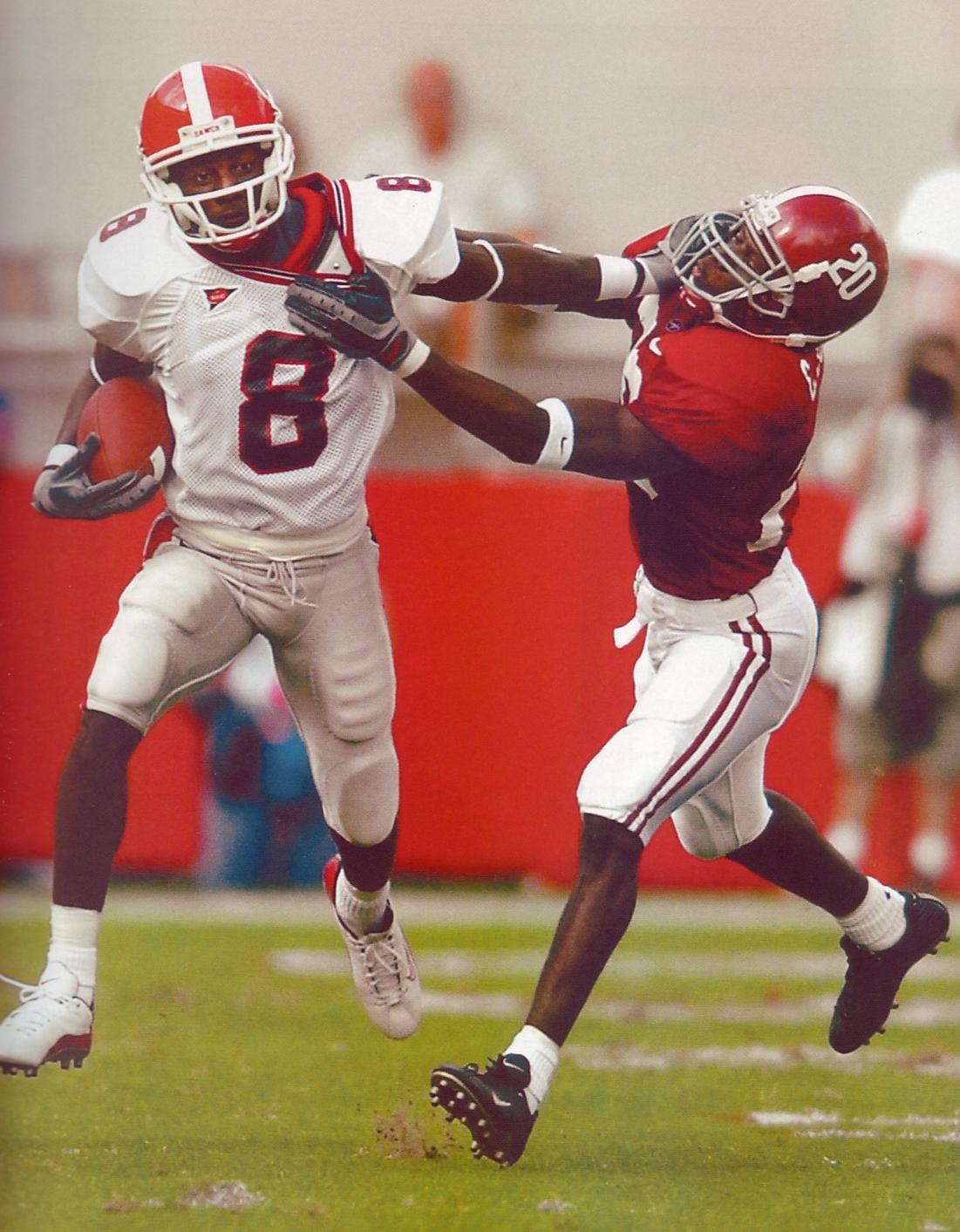
Terrence Edwards—the SEC's all-time receiving leader, who also wore the No. 8 that is now more famously associated with A.J. Green—caught 204 receptions in his career. Green, to date, has 122. Given the fact that Green might forgo his senior season for the riches of the NFL (he's a projected top 10 pick), Edwards' appears safe.
That said, both Fred Gibson (161 ) and Mohammed Massaquoi (158) totals are well within Green's reach and it's possible that he enters the all-time list at third before the close of the 2009 season. Brice Hunter is second all-time with 182.
2. Yards Receiving—Career
Terrence Edwards also holds this record—not only at Georgia, but in the SEC—as he accumulated 3,093 receiving yards at Georgia.
Fred Gibson ended his career trailing closely behind Edwards with 2,883 yards (imagine what Gibson could have done if he had been blessed with Green or Edwards' work ethic—hmmm). At present, Green's total rests at 1,986 yards. He needs only 112 more yards to surpass Lindsay Scott (5th), 296 to pass Mohammed Massaquoi (4th), and 387 more to overtake Brice Hunter at third—all very possible this year.
3. Average Gain Per Reception—Career.
The great Gene Washington, who is most remembered for his part in the Bulldogs 1975 victory over the Florida Gators (Appleby-to-Washington) averaged 24.6 yards per reception over the span of his four-year career at Georgia.
A.J. Green is currently averaging 16.33 yards per catch for his career—including games played this season. It doesn't seem likely that he will catch up to Washington, Bobby Watson (20.7), or Rex Puntal (20.5) before he ends his career at Georgia.
4. Touchdown Receptions—Career
Terrence Edwards leads the way with 30. It's amazing that Edwards was so dominant during his time, but most of this generation are not likely to ever associate the No. 8 with him again—sad.
Green has 17 career touchdowns entering his third game of the 2010 season. Given the propensity of Aaron Murray to look for Green first, in the redzone, it seems feasible to believe Green will add 6-7 more grabs to that count. If he does, he will easily slide into 2nd place behind Terrence Edwards with a chance to surpass him altogether if he returns for his senior season.
Points to Consider:
The legend of A.J. Green at Georgia, and around the country, hinges more on his skills than his production. While no one can deny he's an absolute beast on the football field, he has been limited in what he can do by several factors:
1) The offense: Georgia is still geared towards the run. The Bulldogs have only one wide receiver in the last 60 years who has tallied a 1,000 yard season—Terrence Edwards did so in 2002 (1,004).
2) The quarterback: Green had the good fortune of playing with Matthew Stafford in both his freshman and sophomore seasons, but his past two years have been somewhat hampered by inexperience at the quarterback spot, coupled with poor offensive play calling by his still-green offensive coordinator.
3) No offensive support: Terrence Edwards had Reggie Brown and Fred Gibson. Lindsay Scott had Herschel Walker). Gene Washington had Richard Appleby. Brice Hunter had Andre Hastings and Hines Ward. Who has A.J. Green had?
Mohammed Massaquoi played for one season after the arrival of A.J. Green and, in that season, Green set records by catching 56 passes for 963 yards and 8 touchdowns. Imagine what he might have been able to do his sophomore season with a decent number two receiver to take some of the burden off of him.
Conclusion:
While Green may never surpass the numbers that some of his counterparts have accumulated at Georgia, he's certainly done more with less than any player one can recall in recent memory. He's great for all the things you cannot find on a stat sheet, and that is why he is held in such high regard by both the fans and the coaches.
He's special and everyone knows that when they see him step on the football field—numbers be damned.
This was supposed to be the year that the Georgia run game took off. Washaun Ealey and Caleb King were supposed to be the guys to make it happen on the ground—leaving Aaron Murray free to rule the air. Everything was supposed to be good for the Georgia offense in 2010 because the end of 2009 showed, without question, that "we run this state".
Well, proof-positive that things don’t always go as planned: Caleb King went back to being the guy that couldn't stay healthy, the offensive line forgot that it still has to supply holes for the backs to run through, and Washaun Ealey left his motivation for playing better on his key ring.
Washaun Ealey turned it on during the second-half of last season and, by the time Georgia met up with Georgia Tech in the finale, it was clear that he was going to be something special. Where has that dominance gone this year?
In 2009, he averaged 5.74 yards per carry (through nine games). This season, he's averaging 4.38 yards per attempt. That's not an altogether bad average, but if you look closer, he isn't doing that well where it matters—on those critical third downs.
In 2009, Ealey had nine attempts on 3rd-and-short (a distance of 1-3 yards), and he averaged 7.22 yards per attempt (h/t cfbstats.com). As a result, Georgia was able to extend drives and force defenses to play the run more aggressively—thereby opening up the passing game.
This season, Ealey is averaging 2.25 yards per attempt—he's not getting it done. That means more attention is on Aaron Murray and his wide receivers. Teams have the luxury of abandoning their rush defense because there is not much threat of the Bulldogs converting a short-yardage situation via the run—hence the offense stalls.
Who’s to blame for this lack of effectiveness?
The first finger, naturally, gets pointed at the offensive line. They aren’t dominating at the line of scrimmage and, as a result, they are getting pushed backwards by opposing defensive lines. It’s an issue we have seen before—it happened on multiple occasions last season as well (the game versus Arizona State stands out).
Was the line overrated this season? Is the chemistry not yet clicking with the starting five? Is it a conditioning issue? Has offensive line coach, Stacy Searles, lost his ability to coach? All of these are questions that have come up—none have acceptable answers. The hope just seems to be that, whatever the problem, it’s fixable and, everything will be fine.
However, just as much of the blame could fall on the performance of Ealey. He isn't running with the same amount of urgency or motivation that he did last season. Despite the questions surrounding the line, he should be doing better than he has thus far. He played well, at times last season, in spite of the line—not because of it.
Perhaps there was more to his rivalry with Caleb King than met the eye. It's no secret that the two fed off each other's energy. With no Caleb to share the load with this year, Ealey might not feel the need to give more than necessary—no true competition is there to unseat him, so why bother.
Does that mean Ealey’s not giving his all? No, but most can agree that some players perform better if they know there is a possibility they will be benched in favor of another. As it stands, at Georgia, there is Ealey and no one else.
Ealey shared carries with Caleb King, Carlton Thomas, and Dontavius Jackson (the latter two to a lesser extent) in 2009. This year, it's just him. He's played nearly every offensive down, as either a rusher or a pass-blocker, and it's not altogether clear that he's built for the increased workload.
Whatever the case, it's clear that this is not the same Washaun Ealey that turned heads last year. He's less confident, less effective, and less exciting to watch on the field. All three of those together contribute to an offense that has become more vanilla by the minute and a passing game that, if not for the legs of Aaron Murray, could be more of a concern.
This is an offense that has talent but, without a significant run game, Georgia is going to continue to struggle to put points on the board. Ealey needs to find his groove again—soon—and perhaps that will start with the return of Caleb King—assuming he’s capable of staying healthy this season.
Kenny McKinley has died. The cause of death has not been officially released but speculation is that it is the result of a suicide.
McKinley was a member of the Denver Broncos at the time of his death, drafted by the team in the fifth-round of the 2009 NFL Draft.
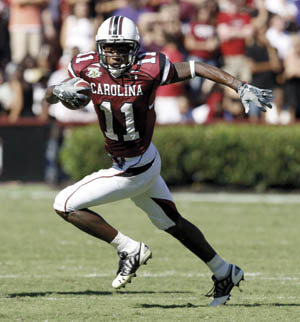
However, fans of the SEC remember him best as being a standout wide receiver for the South Carolina Gamecocks. He, along with current Minnesota Viking, Sidney Rice, formed a talented duo for Steve Spurrier from 2005 to 2006.
After Rice's departure, McKinley continued to light up the field with his big play ability and sure-hands. He never let up, despite his tussle with injuries in his final season, and by the time he closed the chapter on his college career, he held numerous records.
He was not expected to be a major factor in the Bronco's offense this season but, said McDaniels, "
"Kenny had a promising future on the football field, but more importantly, he was a great teammate whose smile and personality could light up the room".
McKinley was only 23-years old.
McKinley's former coach, Steve Spurrier, was surprised to hear the news of his death. Spurrier stated that McKinley was present at the Gamecocks' game against Georgia a couple weeks ago and seemed in good spirits. Spurrier was visibly shaken by the news and seemed genuinely perplexed at what might have prompted McKinley to take such a drastic measure. (h/t TheBigSpur)
Highlights from McKinley's 2008 season with the Gamecocks:
Mckinley speaks on his future with the Denver Broncos shortly after being drafted in 2009.
After the disappointment of the A.J. Green suspension set into the minds and hearts of Georgia Bulldog fans, an alarming trend began to take place—suddenly, Georgia became a mediocre team. That's right, all of a sudden, Georgia became incapable of winning the game on Saturday.
Well, hopefully, that's not the message the fans in Bulldog country are trying to send to the rest of the players on the Georgia Bulldog roster who will travel to Columbia—ready to play—on Saturday because if it is, it's an awful one.
Look, here's the fundamental problem with the "we can't win without A.J." theory, it doesn't take into account that other players on the roster are every bit as skilled in the areas necessary to win the game as Green is—the difference being that Green had it all in one pretty package.
That said, at last check, Georgia has other wide receivers who are capable of running fast (Tavarres King), catching the ball (Kris Durham and Marlon Brown), stretching the field (Rantavious Wooten and Israel Troupe), and getting into the end zone (Aron White, Orson Charles...etc, etc)—that trait is not specific to A.J.
While there is no denying the fact that Green is a dynamic player who brings a lot to the field by simply being there. There is also little doubting this fact: Georgia has won without him...six times. Trust this much, Richt isn't somewhere crying in his lemonade (neither is Todd Grantham) over A.J's loss. Similar to last season, Georgia will look to other players to step-up and fill in the blanks.
And, another thing, this game won't mirror the 41-37 shoot-out of 2009. The 2010 version will be won in the trenches. Georgia isn't going to try and go tit-for-tat with the Steve Spurrier, they will try and run it down the throat of the questionable South Carolina defensive front.
That said, it would have been a far greater loss to the team if running back, Washaun Ealey, were forced to sit on the sidelines. Ealey will be counted on to use the energy he saved by missing game one to run over and through the Gamecock's defense in game two.
If he can do that, quarterback, Aaron Murray's job will be that much easier in the passing game. Furthermore, in those critical third down situations that Green is so money in, Murray will likely look to the hands of Kris Durham, Orson Charles, or Aron White (expect to see the tight ends on the field a lot more this week) to fill the void—all of them are capable of making solid plays in that situation.
The point is, Georgia is anything but done for this week so fans should be conceding nothing—unless, of course, you are one of those who already penciled this as a loss (with or without A.J.). If that's the case—carry on.
Green's suspension is a setback, no doubt about that, but to intimate that his absence is going to turn the team into a pushover is not only a slap in the face to the defense, but a mockery to an offense that is going to look a bit different with Murray standing under center.
Hang in there, Bulldog Nation, there is still plenty of fight in these Dawgs!
The final word came down this afternoon and—after this Lady finished setting things on fire—it became alarming clear that the NCAA is full of shhhh...wait, this is a public blog, let me be careful about this statement.
Ahem, let's start again.
After hearing about the four-game suspension of Georgia's star wide receiver, A.J. Green, it became clear that the NCAA is one big ball of hypocrisy.
How on earth did they justify suspending Green four games for selling his jersey...on Ebay? They say the buyer "meets the NCAA definition of an agent"? Uh-huh, did A.J. know that his buyer was a bloodsucking vulture when he made the sale?
Last I checked, the profile of the sellers and the buyers on Ebay aren't necessarily an open book.
Furthermore, isn't this the same NCAA that gave the thumbs up to Jeremiah Masoli to continue playing college football? Lest we forget, despite what Houston Nutt espoused about second chances and whatever else he says to keep a clear conscience at night, Masoli was convicted of a crime and is, by all accounts, a criminal—yet he gets to play football on Saturday?
Too harsh?...Okay, lets try another, less sinister, example.
Isn't this the same NCAA that told Alabama defensive player Marcel Dareus that he would only need to sit for two games after he (knowingly, mind you) took $2000 in benefits from an agent at a party—that he took a flight to attend?
Sooooooooo, it's okay to accept gifts from an agent, or be a criminal, but it's not okay to make a profit from selling your own damned jersey?...Give me a break!
How many No. 8 jerseys are walking around Sanford Stadium on any given Saturday? You think the school and the NCAA isn't making money off of that sale?...Ludicrous is what this situation is, and it's high time the NCAA do a little more investigating into their practices because, from this vantage point, they look suspect as hell.
Listen, there is no denying that what Green did was wrong because, at the end of the day, rules are rules, but to give him four games is a bit excessive—much like the celebration penalty last season that—in the eyes of many—cost Georgia a win over LSU.
But, no need to digress.
As for the team and how they will adjust, well, this suspension just means it's time for the Georgia Bulldogs to hunker down and do what they need to in their stars' absence.
A.J. is out so...STEP UP, Marlon! Catch the ball, Rantavious! Git' er' done, Tavarres! The team is counting on you guys, along with Israel Troupe, Kris Durham, and Logan Gray—show us what you got.
As for the AJ Green ruling, Georgia is appealing—as well they should—and, hopefully, the NCAA will come to their senses. Although, given the time it took for them to come down with this decision, it seems doubtful that they will change their minds anytime soon.
Tough break for Georgia, with South Carolina looming on Saturday, but hopefully the dimming of one star simply means the emergence of another. Stay tuned for more commentary on this later—after the Lady calms down, that is...*mumbling*...four games, what a bunch of bullshhhhhhh....(sorry, public blog, gotta be careful)
Is it possible to say that without someone wanting to place me on a skewer, hang me over a blazing fire, and roast me until I reach maximum temperature?...Is it?
Showboats and attention-seekers are a turn-off. Some fans find a playful attitude towards the game of football to be charming or good entertainment—but it's not. Football can be entertaining minus the circus, minus the drama, and minus the arrogance that many of its players seem to exhibit today.
Back when the game was only about "wins" and "losses", players often played with more purpose and a whole lot more discipline on the field. There was respect for the beauty of the game—the fundamentals—no one was trying to pull the attention to the name or the number stitched across the back of his jersey.
Individual recognition ran a distant second to winning championships and playing for Super Bowls. Nowadays, a guy has one good year and decides to hold-out for more money. Or, better still, rookies who have never played a down look to be treated like veteran pro bowlers—expecting a big paycheck before they even bother to grace a pro field.
It's a "screw you, pay me" mentality and it ruins the game for the purists who just want to see good football played on Sunday.
Of course, the natural argument against this thinking is to say that there weren't as many opportunities for individual recognition back then because there was no free agency, no internet, no Twitter, and no ESPN—guys played with anonymity back then because they were...well...anonymous.
During that era, one could probably list on one hand, possibly two, the number of players they would recognize minus their helmet, and most of them were quarterbacks. There simply wasn't as much of an opportunity to take advantage of ones own popularity as there is now.
Fair enough, but, even so, can you imagine former Washington Redskins great, Art Monk, wearing an Ochocinco jersey in the place of his No. 85?
Is it reasonable to argue that even the old school players would have liked a shot at the money that players of today make. After all, they weren't all just hoping to play for free—right. Of course, many of those guys will tell you they played for pennies back then and never could have dreamed of making as much money as even a veteran bench player does now—just ask Gale Sayers.
That said, can you think of a player today who would even bother to pick up a football if they didn't think it would net them a large paycheck in the future? Make no mistake, the mentality is different—no matter the era.
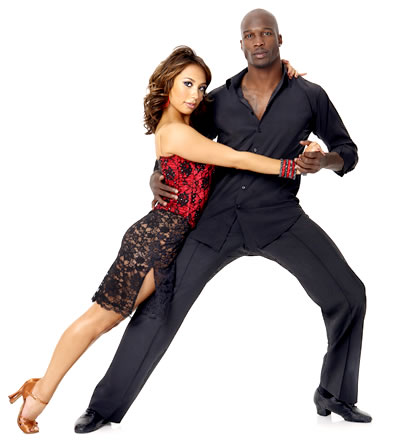
Is there anything wrong with a man making a living off his name? Of course not, Chad Ochocinco should feel free to do so for as long as he can. If he wants to go "Dancing With The Stars", find "The Ultimate Catch", or run around naked in public places (well, assuming he was given the clearance), then that's his business.
That said, changing his jersey to Ochocinco, tweeting during a preseason football game, and blowing off a voluntary conditioning program to enhance his popularity—popularity he wouldn't have without the game of football—seems like too much.
All of it is out of line.
Now, before the Ochocinco fans point out his great play and consecutive 1,000 yard seasons, please understand that the issue isn't his contribution to the Cincinnati Bengals but rather his need to always be maximizing his "brand". It's all Chad...all the time. That's a problem.
He has every right to remain Chad Ochocinco. He has every right to build his brand. He has every right to maximize his bottom line—in any way that he can. But, sometimes, it would be nice to look on the back of that No. 85 jersey and just see the name "Johnson" again and feel confident that his reason for scoring a touchdown was to get his team to the next level and not his face on the camera.
In the end, no one will likely care what he does this season because they, again, think it's entertaining and not hurting anybody. If anything, he's probably adored even more by his fans for the stunts he pulls.
However, if his numbers falter, if he gets an injury, or if his team doesn't do as well as most are hoping...what will you think of him then?
The final word is in and the decision is final, Christian LeMay, the highly-touted QB recruit out of North Carolina, will not play his senior season of high school football for the Butler Bulldogs.
LeMay, suspended back in June for committing a violation of the Charlotte-Mecklenburg School's (CMS) code of conduct rule, appealed the decision of the disciplinary board on July 26th—hoping for some leniency on what LeMay's father described as a "youthful infraction" which did not involve violence or weapons.
LeMay was given a 40-day suspension (total) for the act, and was told that he could return to Butler after his suspension was served. However, by doing so, LeMay would have all but forfeited his senior season as the starting quarterback for his high school football team.
The senior LeMay introduced the possibility of his son finishing out his career at a private school, but was hopeful that the situation would not come to that end.
However, after their appeal was denied, the family felt the best route for Christian to take would be to complete his studies in a "private setting" and enroll at the University of Georgia in December—as initially planned.
He will continue to work independently with a trainer and QB coache until that time so that he can remain in football shape.
His commitment to Georgia remains solid, as evidenced by the statement below, and also gives the impression that the touches Georgia Bulldogs are still high on him as well.
No word yet on how this might affect his overall recruiting ranking, or if there is any reason to believe that this will affect his standing with the UGA admissions committee—currently the latter is not thought to be a concern, but one never knows in situations like these.
We first want to thank all of those who have supported our family during this time. The e-mails, letters, text and words of encouragement have been life fueling from supporters of Christian both locally and nationwide. We specifically want to thank (incoming Georgia recruits) Christian Conley and Ray Drew for standing with our son and contacting him daily, Panthers wide receiver Kenny Moore and QB training coach Steve Calhoun for working him out over the summer. Also, Sporting News and all the other recruiting networks that maintained Christian’s National Ranking on their boards.
As a result of Christian’s youthful infraction (that does not involve drugs, weapons or any form of violence), Charlotte Mecklenburg Schools imposed a severe punishment on our son ... which we appealed to their highest form of due process.
On July 26th the CMS board maintained the merciless ruling of a 40-day reassignment to an alternative school “to possibly be reviewed in 30 days”. (This was) in addition to a four-day suspension already served. The ruling also states that after completing the reassignment days, he could “possibly” return to Butler, meaning it is “possible” that he could not return to Butler.
Adhering to such a severe ruling would not only prevent Christian from playing until November due to the 10-day conditioning rule (if he returned to Butler HS), but it would also hinder him academically as the alternative school does not provide the required classes needed for him to finish in the fall of 2010 and move on to the University of Georgia in January.
Given the unwillingness of CMS to apply a more reasonable consequence for such a youthful infraction, as disheartening as it is, we must make the decision to move on and focus Christian’s attention to preparing for enrollment at the University of Georgia in January. Although, rumors suggest that Christian would likely transfer to one of the excellent programs such as (Duncan) Byrnes (S.C.), (Rock Hill) South Pointe, Greensboro Dudley and even Victory Christian Center, Christian could not imagine playing his senior season at any place other than with his brother Uriah and his teammates at Butler High School.
Therefore, having come to resolve that following the CMS consequence would not accomplish “student achievement” for Christian, we as a family have concluded that he will forgo his senior football season and focus on his preparation to attend the University of Georgia.
We are quite honored that other colleges continue to show strong interest in Christian attending their school. However, we have continued healthy communications with (Georgia) coaches and the commitment remains the same on both ends.
Christian will now prepare himself for the next season of his life as he takes this time to become stronger, spiritually, academically and physically. With the help of fitness trainer Andy Hendel of Cross fit Charlotte and QB coach Steve Calhoun of Armed and Dangerous, Christian will certainly be prepared to arrive in Georgia this spring ready to compete. We are fully confident that his best days are still yet to come. GO BULLDOGS!!!
The LeMay Family
So, what say you? Are you concerned that LeMay won't have any on-field action this season?
When you think of the Georgia Bulldog secondary, several names are likely to come to mind—Brandon Boykyin, Branden Smith, and Vance Cuff—to name a few. However, unless you have been living under a rock, the name Derek Owens has likely found its way into a conversation or two lately as well.
Both Todd Grantham and Scott Lakatos have been impressed with what they have seen from him so far this summer and, in light of Branden Smith's "academic issues" and the relative lack of depth his absence would create, Owens has begun stepping up his efforts even more in hopes of finding more playing time this season.
A Jacksonville, FL native, Owens was a member of the 2010 signing class and, amidst the overall disappointment exuded by fans, he was likely lost in the shuffle of the bigger named players like Alec Ogletree, T.J. Stripling, and Jakar Hamilton.
However, despite his relative anonymity, Owens is a true talent with a lot of untapped potential. The very fact that he chose to stay at Georgia over the summer to study the playbook in preparation for the coming season, shows just how dedicated he is to getting better and making a genuine contribution to the team this year.
In the way of skills, Owens played both defensive back and wide receiver in high school. He doesn't have world-class speed but he has above-average instincts and great hands. He also breaks to the ball well—a trait that will excite Bulldog fans who saw one too many bad angles taken by secondary guys in coverage last year.
Furthermore, as a standout two-way player for Andrew Jackson High School, Owens averaged 39.6 yards per punt return—mostly due to his elusiveness. That could come in handy on special teams despite his lack of track speed. Again, what he lacks in speed, he makes up for in instincts and overall field vision.
He's a quality player who truly wants to find his place onto the football field sooner, rather than later, and with the uncertainty surrounding Branden Smith, he might get his wish. Either way, Owens isn't expected to play as anything more than a reserve this year–Vance Cuff still has the inside track on starting opposite Brandon Boykin.
Still, coach Richt has already made it clear that a good many guys will get a shot to play early because he would like to keep legs fresh—so anythings possible.
Owens has already proven he's got the drive and the skills to play a significant role at Georgia in 2010, all he needs now is the opportunity.
Don't be confused by the hype-machine about Dez Bryant, he may have been "electrifying" in his first practice, but color me unimpressed until he actually plays a real football game.
I watched him play college football for nearly three seasons and while he has the frame to be a magnificent pro, he was inconsistent in the college ranks. He manhandled the weaker competition he came up against in the Big 12, but often struggled against the better ones. He's good but he's not nearly the god the media is touting him to be—yet.
So forgive me if I'm a tad skeptical about how well Bryant did in practice—we are talking about practice right? Not a game, not a game...PRACTICE!
However, the comical part wasn't the media jockeying of Bryant, but rather his one act of defiance in refusing to accept the hazing offered him by Roy Williams.
After many of us stopped laughing, it came down to the business of asking one of two questions, either "who does Dez Bryant think he is," or "who does Roy Williams think HE is?"...either way, tongues were wagging.
Dez Bryant's reasoning, "I'm not doing it, I feel like I was drafted to play football, not carry another player's pads... I'm saying that out of no disrespect to (anyone)."
Fair enough, right? I mean, after all, Bryant is getting paid $11.8 million to catch the ball for Dallas, something that Roy Williams has done a poor job of over the last several seasons. Bryant probably doesn't feel Williams is worthy of asking him for such a thing—what has he done to be afforded that level of respect?
And, honestly, if this were Jason Witten, how likely is it that he would have denied that request? Just saying. Roy Williams can be as diplomatic as he wants about the fact that the Cowboys found it necessary to draft a receiver in the first round but, the fact remains, his clock is ticking.
My bet is that this will be Williams' last season in Dallas (especially if Bryant performs as expected...or even close). Williams' knows it. Bryant knows it. So, again, why should Bryant feel the need to cow-tow to the man who may soon be sitting on the bench, watching him snag balls from Tony Romo?
I understand that, in the end, it's the principle of the thing, and I am sure that after this little brouhaha is over, Bryant will be pulled to the side and told as much but, seriously, carry Roy Williams' pads?...Not even I can blame him for denying that request.
Four players earned a place on the first team, as A.J. Green (WR), Drew Butler (P), Blair Walsh (K), and Clint Boling (OL) all made the cut.
Heading up the second team were Cordy Glenn (OL) and Brandon Boykin (DB)—Boykin made the team as a member of the special teams. His multiple 100-yard returns last season, no doubt, played a part in the selection.
However, what's more intriguing than who did make the list was who didn't.
Justin Houston, the Georgia Bulldogs standout defensive end who, despite missing the first two games of the 2009 season, racked up 38 tackles, 14.5 tackles for loss (2nd in the SEC), and 7.5. sacks (3rd in the SEC) didn't receive a nod.
It's a head-scratcher considering the expectations for him in 2010 are very high. The talented player, who recently made the move to outside linebacker, is considered by many to be in line for a stellar year playing in Georgia's newly installed 3-4 defensive scheme. And, depending on his success this season, there is a good possibility that he could become an early round selection in next year's NFL Draft.
So, it begs the question, how on earth did the coaches see fit to leave him off the list?
Did his suspension at the start of 2009 play a role in their decision?
Did the lack of eye-popping tackles overshadow his other more impressive stats?
Whatever the case may be, it's clear that Houston still has some proving to do in the SEC and I have no doubt he's more than ready for the challenge.
The arrests of Tavarres King (WR) and Dontavius Jackson (RB) cast another shadow over the football program, the result of which will mean there will be more depth chart shuffling.
At the end of spring practice, Tavarres King won out over Rantavious Wooten for the No. 2 receiving spot behind A.J. Green. The competition would likely have stretched into the summer, but King had a decided edge over Wooten in their position battle. Now, with King’s mandatory one-game suspension being a factor, the door is open for Wooten or someone else to grab the reigns—at least in game one.
King was one of Georgia’s best deep ball threats and there were some who felt that 2010 would be his breakout season. Now, it is unclear when he will play and that means someone else will be counted on to step up and fill his void.
The Bulldogs have one incoming receiver for 2010, Michael Bennett. His development will be watched with more interest now as he could be called upon early to contribute. It will be interesting to see how he adapts to the rigors of the SEC, both physically and mentally, because there is little doubt that he has the requisite skills.
The most likely scenario is that Bennett fills in as a reserve and Marlon Brown or Rantavious Wooten battle it out this summer for the No. 2 spot—assuming Brown can remain healthy and Wooten can cure what ailed him during the spring where he seemed to struggle with dropped balls.
If neither of them can secure the job, look for Kris Durham to make some noise. He looked impressive in the G-Day Game and he has always been a good possession receiver for the Bulldogs throughout his career—despite limited opportunities to shine.
At the running back spot, the loss of Dontavius Jackson—who was slotted in at third on the depth chart, with Carlton Thomas trailing slightly behind—is a touch more worrisome. Despite the talented tandem of Washaun Ealey and Caleb King, a third back would be nice insurance against injury and fatigue.
The obvious choice to replace Jackson would seem to be Carlton Thomas. He looked good during the spring and, for the second year in a row, was impressive in G-Day.
However, last season highlighted some weaknesses in his abilities—mostly due to his size—and the fact is, he is not an every down back. He has a very specific skill-set that the team will use where possible but he’s not the long-term answer.
The natural fit for the role is likely to be incoming freshman, Ken Malcome. He has the size and strength for running the ball between the tackles and his balance and vision make him intriguing as an early contributor.
He lacks the speed of Dontavius Jackson but his style closely mirrors that of Washaun Ealey and that's not a bad thing.
Will he be ready to jump in and make it happen? We'll just have to wait and see this summer, but with the lack of warm bodies on the depth chart at running back, Malcome will definitely be in the mix.
Hopefully the opportunity to move up on the depth chart will spark greater competition amongst those who are fighting to make a statement for the Bulldogs in 2010.
On Saturday morning, two more Georgia Bulldog players landed in hot water because of alcohol. Georgia wide receiver Tavarres King was charged with underage possession and will receive a mandatory one game suspension.
His teammate, Dontavius Jackson—a spring game standout at running back—was charged with a DUI, underage possession, leaving the scene of an accident, and several other traffic violations. He is suspended for a minimum of six games.
Both players are suspended indefinitely from team activities.
The natural response to this most recent development is, what is with the Georgia Bulldogs football team this off-season? It's a fair question. After all, did King and Jackson not learn anything from the dismissal of Zach Mettenberger and Trent Dittmer—both of whom were kicked off the team as a result of using poor judgment whilst under the influence of alcohol?
I mean, it’s not rocket science, right? Even the disgraced former AD, Damon Evans, understood the concept—You Drink...You Lose.
So, again, what’s the problem in Athens, GA? Honestly, the problem goes a lot deeper than a few bad apples.
The knee-jerk reaction is to blame the coaches, blame the culture, and blame the lack of discipline for everything that has gone wrong so far. However, I would contend that you don’t have to look very far in Athens, Knoxville, Iowa City, or Ann Arbor to find a football player with a drink in his hand—most of whom are underage.
I would also argue that the boosters, fans, bar owners, and bar patrons in these places are every bit as guilty as the players themselves because, in many cases, they put that drink into their underage hands. However, little attention is usually given to how a player obtained the alcohol or entry into an establishment that only serves alcohol.
That said, I feel confident in saying that for every player that ends up in the police blotter, there are scores of others who won’t and, likely, never will. Some will last their entire career at Georgia and no one, outside of Athens, GA, will ever know just how bad a reputation they truly had off the field.
As for the ones who won’t escape trouble, they can hardly feel too bad about being caught. We live in an age where social media (Twitter, Facebook, Myspace, etc.) rules and few places offer shelter from the 24/7 public scrutiny you will receive as an athlete.
30-years ago, if a football player got into trouble, there was only that team’s lone beat writer to tell his story. In many cases, the tale was relegated to the local paper and it never went to the state level—much less the national one.
These days, anyone with a camera-phone and a swift network connection becomes an instant reporter—even worse if they are on Twitter. Tennessee beat writer, Wes Rucker, just happened to be at Bar Knoxville when the fight between the football players and the police officers broke out. He immediately let people know about it—on his Twitter feed.
The co-owner of Bar Knoxville, where the infamous brawl took place, spoke of giving the football team the “VIP” treatment. That “VIP” treatment included players not having to pay a cover charge for entry into the establishment.
Do you honestly think that Knoxville is the only College Town, U.S.A where that goes on?
Accountability needs to be had by all responsible if the culture of underage drinking in athletic programs is going to be contained even the slightest bit. Neither Dontavius Jackson, Tavarres King, nor their companions that night were old enough to drink—who bought it for them?
I won’t discount the possibility of fake I.D.’s and off-campus parties where alcohol is freely available—I am not naive to the fact that there are many ways to obtain alcohol even if you are underage.
However, I will say that athletes are more likely to be given special privileges by local bars and restaurants because they want the business, the prestige, and the honor of saying that they have a relationship with the Georgia football team and its players.
For some, that is enough to overlook an alcohol sale here and there. Especially when no one is likely to report the violation when it happens.
This off-season at Georgia, and many other university towns, has seen far too many of the same story lines. How much more has to happen before we start to understand that the overall repercussions to the program, its players, and the surrounding community is far more important than the points gained on the infamous “Fulmer Cup?”
In the end, the football players who are stepping outside the lines and behaving badly are not above reproach. They deserve to be punished and they are responsible for their own behavior—no question.
However, at what point does the at-large-community (bar owners, patrons, etc.) start to take some of the responsibility for fostering this sense of entitlement and allowing it to continue?
Your comments and insights are always welcome—even if you completely disagree—share your thoughts.
Despite the lack of depth the Georgia Bulldogs have at wide receiver for 2010, Michael Bennett’s name hasn’t been mentioned much as a potential target for Aaron Murray. This lack of notoriety is a familiar scenario for the young man from Alpharetta, GA.
Bennett was referred to as the “most underrated wide receiver” prospect in the state for 2009 by MaxPreps. He didn’t even receive any Division I offers until after his performance at the 2009 Atlanta National Underclassmen Combine (NUC).
It was there that he took home the prestigious ‘Combine King’ award after making mince meat of the competition in both 7-on-7 and 1-on-1 drills.
His impressive performances continued into his senior season at Alpharetta High School (AAAAA), where he finished the year with 1,084 all-purpose yards, 7 touchdowns, 35 tackles, 2 interceptions, and 693 rushing yards.
Now, he hopes to carry his productivity into the SEC where his goal is to be a solid contributor for Georgia—early.
Many have compared Bennett to current Georgia Bulldog receiver, Kris Durham, and while the two are similar in size and build, that is where the similarities end. The more film you see on Bennett, the more you realize that he is a very special player with more talent than he's been given credit for—in my opinion.
His size, speed, vertical leaping ability, and overall approach to the game is very similar to that of current Georgia standout, A.J. Green (who, coincidentally, Bennett states he has tried to model his game after). He has a tremendous ability to make the catch—no matter the situation—and his body control while in the air is something to see.
The latter was something that scouts were equally impressed by during their evaluation of him at the various summer camps he attended during his junior season. . He was fearless when going up to make the catch and his willingness to sacrifice his body for the ball made for some highlight reel catches on the field.
He doesn’t mind contact either (he also played some defensive back in high school) and, coming to the SEC, he has committed himself to getting stronger so that he is prepared to take the hits that will surely come his way as a result.
It’s that kind of dedication that has the coaches excited about his long-term potential.
As of now, it’s uncertain what will happen with Bennett for 2010. If he’s ready, and performs well this summer, it may be difficult to keep him off the field. However, with the maturation of Marlon Brown and the return of Kris Durham, it may be difficult for him to gain much in the way of playing time as the teams 5th or 6th option.
That said, Bennett is preparing like a guy who expects to play this year—he is not looking to redshirt in 2010. His understanding is that his opportunity to play will come sooner, rather than later and if it does, Georgia fans should be surprised by what they'll see.
If nothing else, he has a ton of upside for the future and it would not surprise me to see him taking on a much bigger role in 2011—particularly if A.J. Green leaves for the NFL as expected (Green is a projected Top 10 pick).
The Georgia Bulldogs will spend the better part of the 2010 season in "hope" mode—as in, they are hoping that none of their six scholarship wide receivers are forced to miss any significant time due to injury or misbehavior.
The Bulldogs are frighteningly thin at wide receiver this year—even thinner when you consider the relative lack of production from the No. 2 spot in 2009. It's an area that is of minor concern to the fans and it has often sparked intelligent debate among those in the Bulldog Nation as to who will fill the shoes that Mohammed Massaquoi left behind in 2008.
That said, the team has been recruiting the position with ferocity this off-season and, as of June 4th, Georgia received it's third wide receiver commitment for 2011. Zach Witchett, another talented in-state product, has made it known that he will be signing with the Bulldogs in 2011—joining Chris Conley and Justin Scott-Wesley on the early-commit train.
Witchett is a 6'0", 186 pound, blend of speed (he runs a 4.43 forty) and athleticism. He adjusts to the ball well in the air and has good long speed for the deep ball. He will definitely bring a nice batch of skills to Georgia—including the ability to play defensive back (although that seems unlikely at the moment).
Georgia isn't going to sign too many more receivers for 2011 (they should cap out at four or five), but two guys do remain a huge possibility—Damian Swann (who has Georgia in his top 5) and Charone Peake (who many feel will either choose either Georgia or Clemson)—both have connections to current Georgia pledges.
Swann has been lobbied by Witchett and Peake has been in contact with Georgia QB commit, Christian LeMay.
For now, the program can relish in receiving its tenth commitment of the year.








![Reblog this post [with Zemanta]](https://lh3.googleusercontent.com/blogger_img_proxy/AEn0k_uvABlqm1dp-Tu_EBuCbkVwiaGeYF63hNCfr6hZnCqI2e7UYf2ck4M_1Q1C-uaVzmWRKj5fxYjEmVzFIET_4CJvG6gXyFiy2dvhRyBHpKLTb3gq8uRziQf_V77DVpdZCO2xHykVcz1Q161Q6eNnKYZd=s0-d)

